Key takeaway: Architectural copper is bought for its patina, which takes decades to cover an entire roof in Quebec. The "bronze" in a specification is often a brass that will never turn green; true bronze is mostly used for wear parts. The alloy, the temper and contact with other metals are set on the drawing.
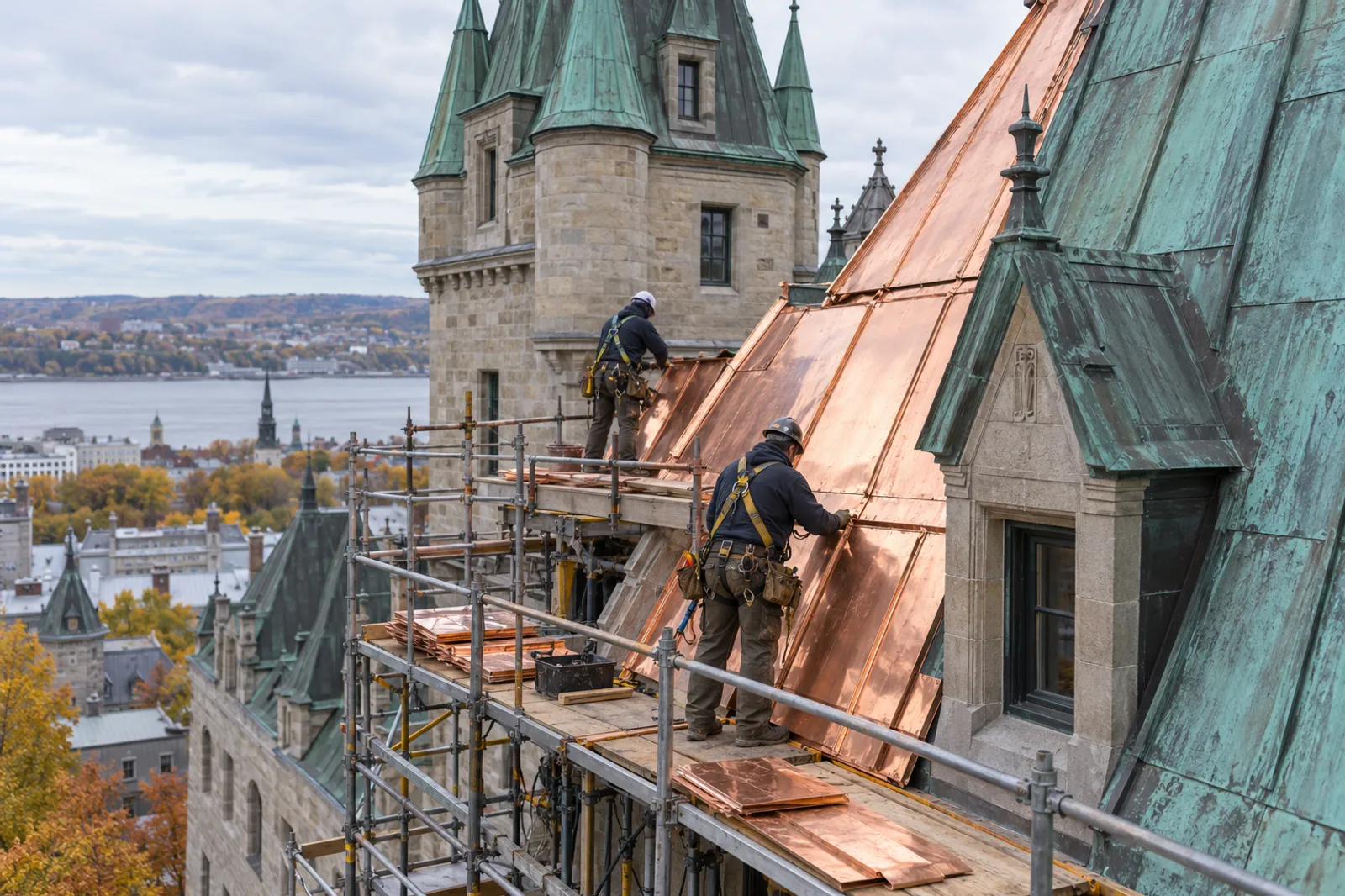
The architectural copper of the Château Frontenac lost its green at the end of 2011. When the trompe-l'œil tarp hiding the roof replacement was removed, the roof appeared in a brand-new copper colour. Radio-Canada reported in December 2011 (in French) that it would take 30 to 40 years for the roof to gradually regain its green colour.
The tower's old copper roof dated from the early 1920s. The green associated with Old Québec is therefore the work of decades of weather, not a colour you order from the shop. It has to be planned from the specification stage.
Copper patina is counted in years, not seasons
In brief: copper cladding stays brown for years before turning green, and in Quebec, salt, snow and frost add to the ambient air in setting the pace.
Fresh from the rolling mill, copper is salmon red. The Copper in Architecture handbook from the Copper Development Association (CDA) then describes a reddish brown, followed by the grey-green patina. The patina forms through a reaction with acidic moisture in the air, faster in cities, by the sea and in industrial areas, where pollutants are concentrated.
In a seven-year exposure study published by ASTM International, copper first developed a dark layer of cuprous oxide. Green only appeared after six to seven years, in both urban and marine atmospheres. A uniformly green roof takes decades more.
The Quebec winter weighs in two ways. The CDA handbook lists salt, along with humidity and sulphur pollution, among the factors that quickly launch copper into its weathering cycle. Cladding installed right next to a sidewalk that gets de-iced receives salty splashes on its first few feet, and its bottom may weather differently from the top.
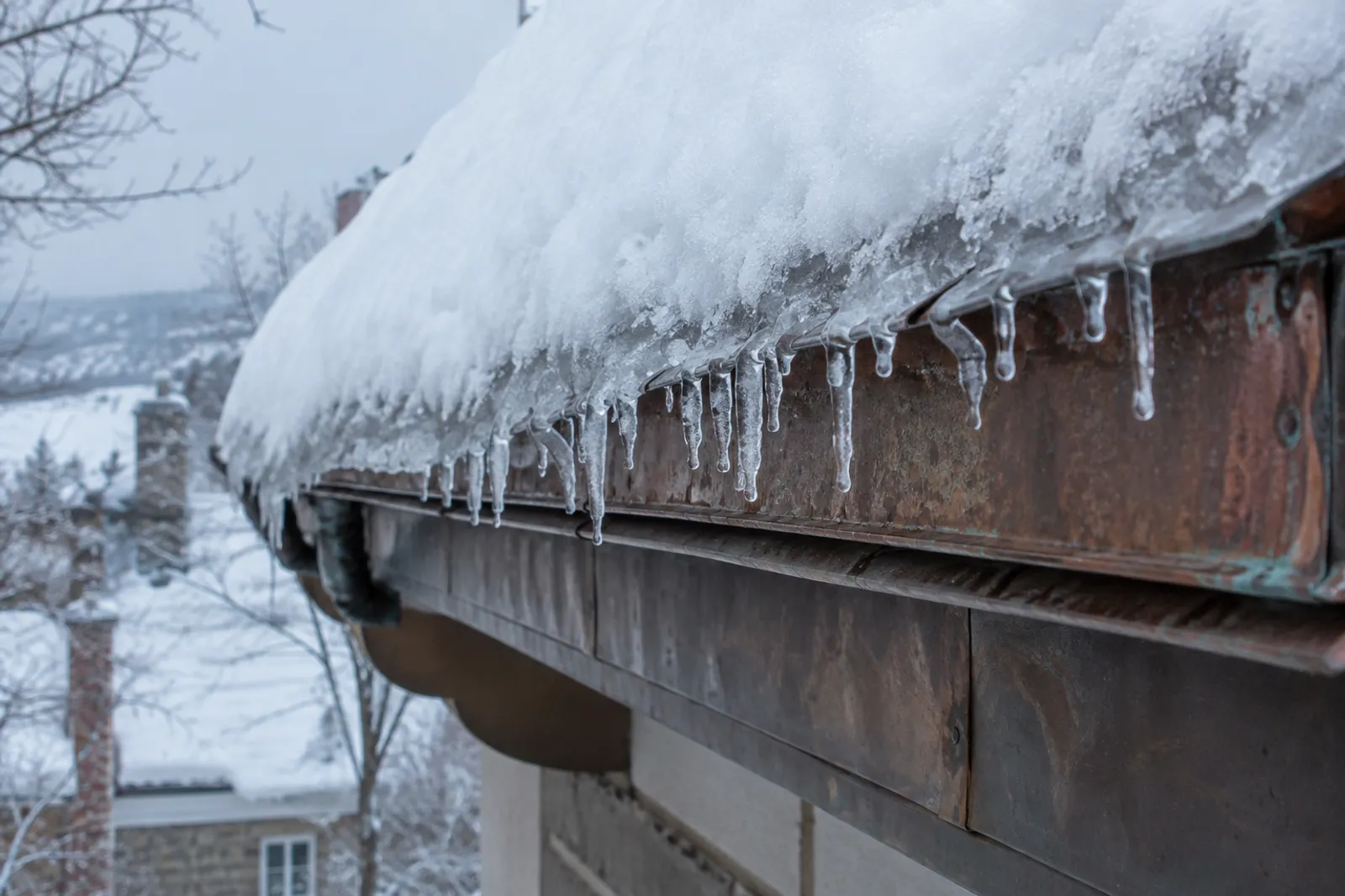
Frost, for its part, threatens watertightness more than colour. Snow melting above a heated space refreezes at the roof overhang and forms an ice dam that pushes water back under the sheets. The CDA then calls for a copper eave flashing of at least 16 oz, extending at least 18 inches past the face of the wall.
Not every face of a building follows the same pace. A low-slope canopy, where water lingers, and the vertical wall it shelters can weather differently, and the CDA points out that natural patinas are "far from uniform". It's a design factor to show the owner, not a manufacturing defect.
The owner has three options: let the metal weather, pre-patinate it chemically in the shop, or lock in its colour under a clear coat, which degrades in sunlight and must be redone. The Monastère des Augustines, at the Hôtel-Dieu de Québec, chose the first. Its four copper roofs, rebuilt identically in 2017, replaced a 1931 covering that had been in place for more than 85 years, and the monastery is counting on natural oxidation (in French) to turn the whole thing green.
Four junctions damage copper work before it even patinates
Copper is more noble than almost every metal used in buildings: the CDA ranks aluminum, zinc, steel, iron, tin and lead below it; only passivated stainless ranks above. When two metals touch in the rain, the less noble one corrodes. On copper work, the loser is therefore almost always the neighbour.
- Aluminum and zinc. The two metals to isolate first, with a paint compatible with both surfaces or a non-absorbent gasket. Water running off copper must not reach exposed aluminum either: copper salts accelerate its corrosion.
- Fasteners and accessories. A galvanized screw in a copper flashing sacrifices its zinc with the first rains. The Conseil du patrimoine religieux du Québec (in French), drawing on a technical guide from the City of Québec, requires cleats, ridges, hips and flashings to be the same metal as the roofing.
- Limestone and marble. Moisture loaded with copper salts penetrates porous stone and leaves a green stain as it dries. A drip edge of at least one inch and gutters that carry water away from the wall limit staining.
- Inert roofing upstream. Acid rain running over shingles or slate isn't neutralized on its way down. Concentrated in a small copper flashing, it can pit the metal before the patina protects it.
Once the cladding is installed, fixing one of these junctions means taking it apart.
Does your facade combine copper, aluminum and limestone? Have the junction details reviewed before fabrication starts.
"Architectural bronze" is a brass, and the purchase order needs to know it
In brief: in construction, the word bronze often refers to a copper-zinc alloy, which doesn't weather like copper and doesn't turn green.
In metallurgy, bronze is an alloy of copper and tin, and brass is an alloy of copper and zinc. In construction, the line blurs: the word bronze is commonly used for alloys that contain little or no tin, because they look like true bronzes. "Statuary bronze" and "green bronze" are colours, not alloys.
For the shop, only the UNS number counts. Here's what common trade names on an architect's specification actually hide, based on the CDA's table of common alloys.
| Name on the specification | UNS alloy | Composition | Colour after weathering |
|---|---|---|---|
| Copper | C11000 | 99.90% copper | Reddish brown, then grey-green patina |
| Commercial bronze | C22000 | 90% copper, 10% zinc | Brown, then grey-green patina |
| Muntz metal | C28000 | 60% copper, 40% zinc | Red-brown to grey-brown |
| Architectural bronze | C38500 | 57% copper, 40% zinc, 3% lead | Russet brown to dark brown |
| Silicon bronze | C65500 | 97% copper, 3% silicon | Russet brown to speckled grey-brown |
With 40% zinc, C38500 architectural bronze is strictly speaking a brass, and no green patina is attributed to it: it darkens toward brown. "Bronze" handrails designed to turn green along with the copper roof will end up in two colours that will never match. Writing the alloy number next to the name settles the question before the metal is purchased.
True bronze, the kind that contains tin, mostly works in plants, where nobody looks at its colour: bushings and bearings in C932 (formerly SAE 660), marine parts in C954 aluminum bronze, springs and contacts in C510 phosphor bronze. These grades are listed on the bronze page, and the pure copper used for busbars on the copper sheet.
For a worn bushing nobody has a drawing for, also measure the shaft and the housing bore: copying the bushing alone reproduces the clearance that years of service have worn in.
Conclusion
Copper is chosen for what time will do to it, bronze for what the machine will put it through.
For a roof or cladding, the order describes the sheet without ambiguity. Standard copper sheet meets ASTM B370: 99.9% copper, in six tempers, from O60 annealed to H04 hard, and cold-rolled copper handles expansion stresses much better than annealed. Thickness is given in ounces per square foot: a 16 oz sheet weighs 16 ounces per square foot, the minimum the CDA specifies for an eave flashing.
The drawing then carries the UNS number, the temper, the sheet weight, the desired finish (natural, pre-patinated or clear-coated), the eave detail and every junction with another metal or a porous stone. Attach this drawing and the list of adjacent materials to the quote request form.
FAQ
How long does architectural copper take to turn green?
At least six years for the first traces, decades for a uniform roof. In a seven-year exposure study published by ASTM International, architectural copper first darkened, then green appeared after six to seven years. At the Château Frontenac, whose rebuilt roof reappeared in copper colour in 2011, it was expected to take 30 to 40 years to regain its full green colour.
Can copper be kept from changing colour?
Yes, but not without maintenance. A clear coating, often acrylic, slows the formation of oxide films and keeps the pink tone of new metal. These coatings do break down over time, especially outdoors in full sun. The old coating then has to be removed, the metal refinished and a new coat applied. Conversely, a chemical pre-patina applied in the shop gives a brown or green colour right away.
What's the difference between bronze and brass?
Composition. Bronze is primarily an alloy of copper and tin, brass an alloy of copper and zinc. In construction, however, several brasses carry the name bronze: C38500 architectural bronze contains 40% zinc and 3% lead, and it turns brown without ever going green. In industry, true bronze is preferred for wear bushings and seawater parts.
Can copper be fastened with galvanized or aluminum screws?
No. The zinc on galvanized screws and aluminum are precisely the two metals the Copper Development Association identifies as priorities to separate from copper. In the rain, they corrode in contact with it, since copper is more noble. Fasteners should be copper, brass, bronze or compatible stainless instead. For an adjacent aluminum part, a compatible paint or a non-absorbent gasket provides the separation.