A plant manager who has never worked with an integrated shop, from drawing to finished part, often asks the same question: what actually happens between sending a drawing and receiving the finished part?
The process may seem unclear from the outside, especially when several subcontractors handle different stages. Yet a custom metal fabrication project generally follows a clear sequence, whether the shop is integrated or the work is divided among several suppliers.
This article explains the seven typical stages of such a project, from the initial drawing to the delivered part, and shows what distinguishes an integrated shop from a more fragmented model.
Step 1: the drawing
Every project begins with a drawing, sketch or description of the requirement. The technical team then assesses feasibility based on the desired alloy, required tolerances and planned volume.
This stage also helps identify possible design adjustments that could reduce costs or lead times without compromising the function of the part. A clear quote generally follows this review, before any production commitment is made.
A technical discussion at this stage, rather than a simple exchange of emails, often clarifies details that would otherwise be discovered only during production, when corrections are already more expensive.
Step 2: 3D modelling and drawing approval
Once the project is confirmed, the engineering team models the part in three dimensions. Computer-aided design solutions integrated with manufacturing can detect interference or design defects before the first sheet is cut.
This model, created in software such as SolidWorks or AutoCAD, then becomes the basis for the shop drawing. The client generally approves this stage before production begins.
Why this stage prevents costly errors
Correcting a design flaw in a digital model costs a fraction of what it would cost once the part has been fabricated. Approval at this stage remains one of the most cost-effective moments in the entire process.
Step 3: laser cutting the parts
Physical fabrication generally begins with cutting. A high-power fibre laser cuts the outline and openings of the part directly from the approved drawing file.
The article on 4,000 W fibre laser cutting explains the thicknesses and tolerances that can be achieved at this specific stage, depending on the alloy used.
Step 4: CNC bending, rolling and forming
Once cut, the sheet takes shape through CNC bending. This stage transforms a flat part into a three-dimensional component according to the angles and bend radii specified on the drawing.
The following table summarizes the most common forming processes used at this stage and their typical applications.
| Process | Function | Typical application |
|---|---|---|
| CNC bending | Forming precise angles | Enclosures, brackets, structures |
| Rolling | Forming continuous curves | Piping, circular frames |
| Deep drawing | Forming recesses or raised features | Vessels, structural panels |
Each process requires different parameters for each alloy, which is why approving the drawing at the previous stage remains critical.
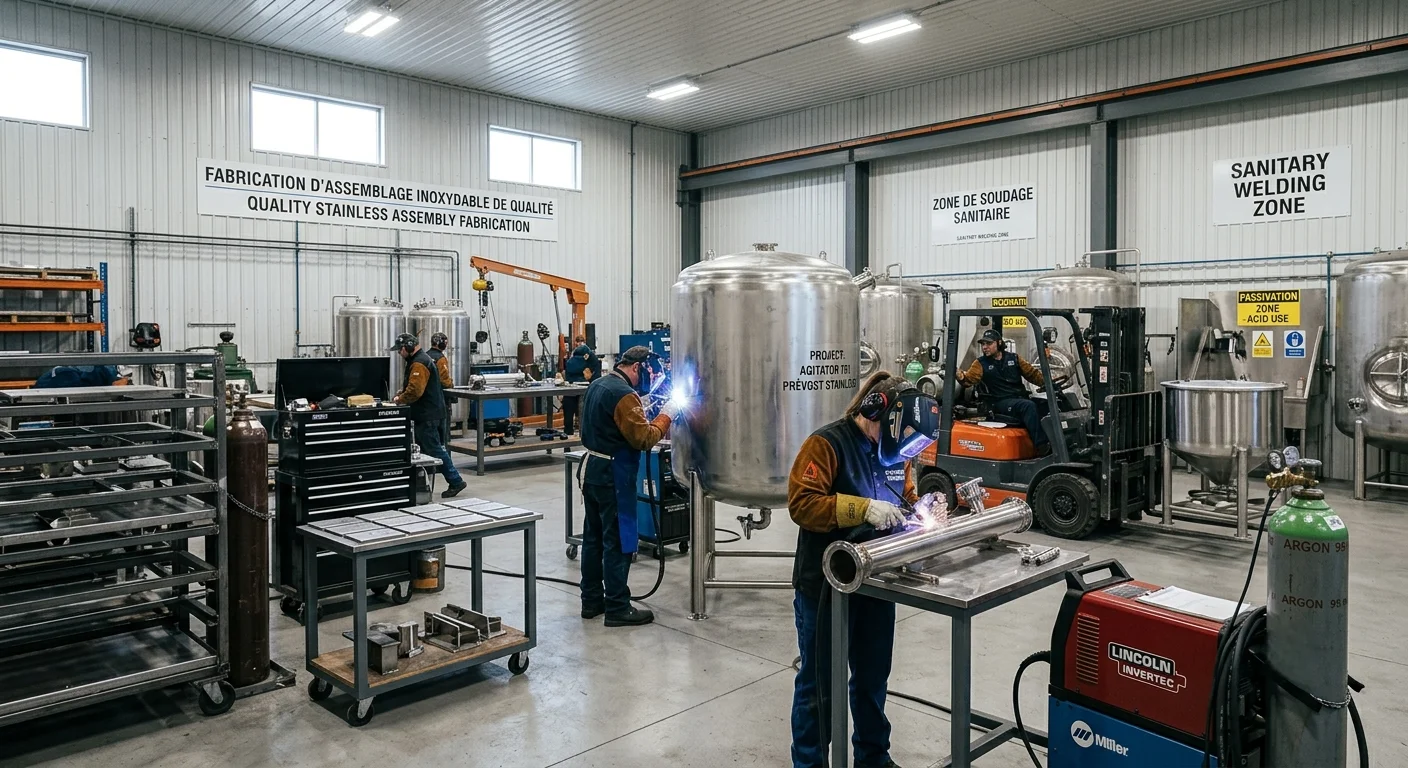
Step 5: certified welding and assembly
The formed parts are then assembled by welding. Certification to CSA W47.1, administered by the CWB Group, ensures that welding personnel have been qualified against independently verified criteria.
This stage largely determines the strength and durability of the final assembly, particularly for structures exposed to loads or corrosive environments.
Would you like to understand how this process would apply to your project? Request a free quote for a detailed technical assessment.
Step 6: polishing, finishing and quality control
Depending on its final use, the part then receives an appropriate polish or brushed finish, ranging from a standard industrial finish to a sanitary food-grade or pharmaceutical finish.
Quality control verifies the dimensions, weld integrity and finish against the original drawing before the part is approved for delivery.
- Dimensional verification against the approved drawing
- Visual and, when required, radiographic weld inspection
- Surface finish inspection based on the intended application
- Alloy and process traceability documentation
Step 7: delivery and traceability
The final stage is to package and deliver the part with its supporting traceability documentation. This documentation becomes important for an audit, warranty claim or future component replacement.
A shop located in Quebec can generally deliver throughout the province, elsewhere in Canada and to the United States, depending on the client’s logistics requirements.
For large parts or assembled structures, transportation and packaging are planned during the project’s early stages instead of being improvised once the part is finished.
Why choose an integrated shop?
A fragmented model, in which each stage is assigned to a different subcontractor, adds transportation, waiting time and the risk of information being lost between each party.
An integrated shop like the one described in the article on metal fabrication in Laval completes these seven stages under one roof, with a single point of contact from the beginning to the end of the project.
This approach also makes it easier to compare suppliers, as explained in the article on criteria for choosing a stainless steel manufacturer in Quebec.
A single point of contact also means one invoice, one person to contact if there is a delay and clear accountability if an adjustment becomes necessary during production.
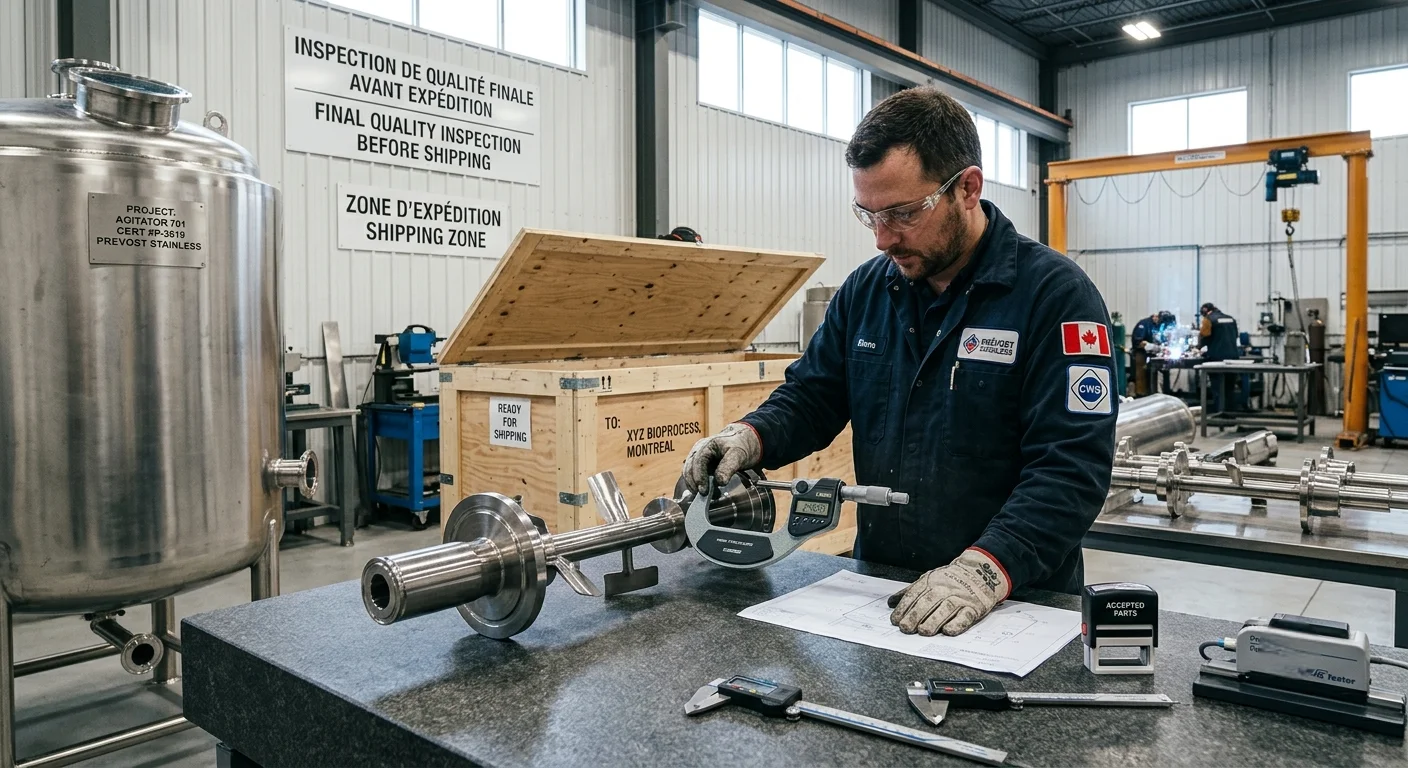
An integrated shop, from drawing to finished part, without intermediaries
Understanding these seven stages allows a plant manager to ask the right questions before starting a project with an integrated shop, from drawing to finished part, instead of discovering surprises after production has begun.
An integrated shop completes this entire process in Laval, from 3D modelling through delivery. Request your free quote to begin your next custom metal fabrication project.
FAQ
What is an integrated shop, from drawing to finished part?
An integrated shop, from drawing to finished part, completes the design, cutting, bending, welding and full finishing of a part under one roof instead of relying on several separate subcontractors. This structure reduces transportation delays between stages and supports complete project traceability, with one accountable point of contact from the beginning to the very end of production.
How long does a custom metal fabrication project take?
The duration varies with the complexity of the part, the number of required stages and the production volume. A simple project may be completed in a few days, while a complex assembly with several finishes requires more time for modelling, production and quality control before final delivery, especially when several alloys or special finishes are combined in one project.
What is the first stage of a custom fabrication project?
The first stage is to assess project feasibility from a drawing, sketch or description of the requirement. The technical team evaluates the desired alloy, required tolerances and planned volume, then provides a quote before any production commitment. This establishes expectations, budget and schedule at the very beginning, well before the part is modelled in 3D.