Stainless steel fabrication in the pharmaceutical industry leaves no room for approximation. Every metal component that enters a manufacturing process must meet precise requirements: material grade, surface finish, documentary traceability, regulatory compliance. Poorly designed or non-standard equipment can compromise the quality of the final product, trigger a non-conformity or expose patients to risk.
This is why choosing a manufacturer for the pharmaceutical sector is no trivial decision. Here is what you need to know to evaluate a supplier and understand the standards at stake.
Why stainless steel fabrication dominates the pharmaceutical industry
Stainless steel prevails in pharmaceutical environments for several fundamental technical reasons. Its corrosion resistance in aggressive chemical environments, its ability to withstand repeated cleaning and sterilization cycles (CIP/SIP), and its non-porous surface make it the reference material for vessels, tanks, piping and structures in contact with active products.
Unlike other materials, stainless steel does not release particles or contaminants into production streams. It meets the requirements of North American regulatory authorities, notably the FDA in the United States and MAPAQ in Quebec for food-grade or biopharmaceutical environments.
Grade 316L, the essential pharmaceutical standard
Among the available stainless steel grades, 316L is the preferred grade for pharmaceutical applications. Its composition includes molybdenum (2 to 3%), which gives it superior resistance to chlorides and common cleaning agents such as NaOH and peracetic acid.
The "L" suffix (Low Carbon) indicates a reduced carbon content, which limits sensitization at grain boundaries during welding. This is critical in pharma, because welds are high-risk zones for intergranular corrosion and the accumulation of contaminants.
316L is also used in fabrication for the food industry, where cleanliness and cleanability requirements are comparable.
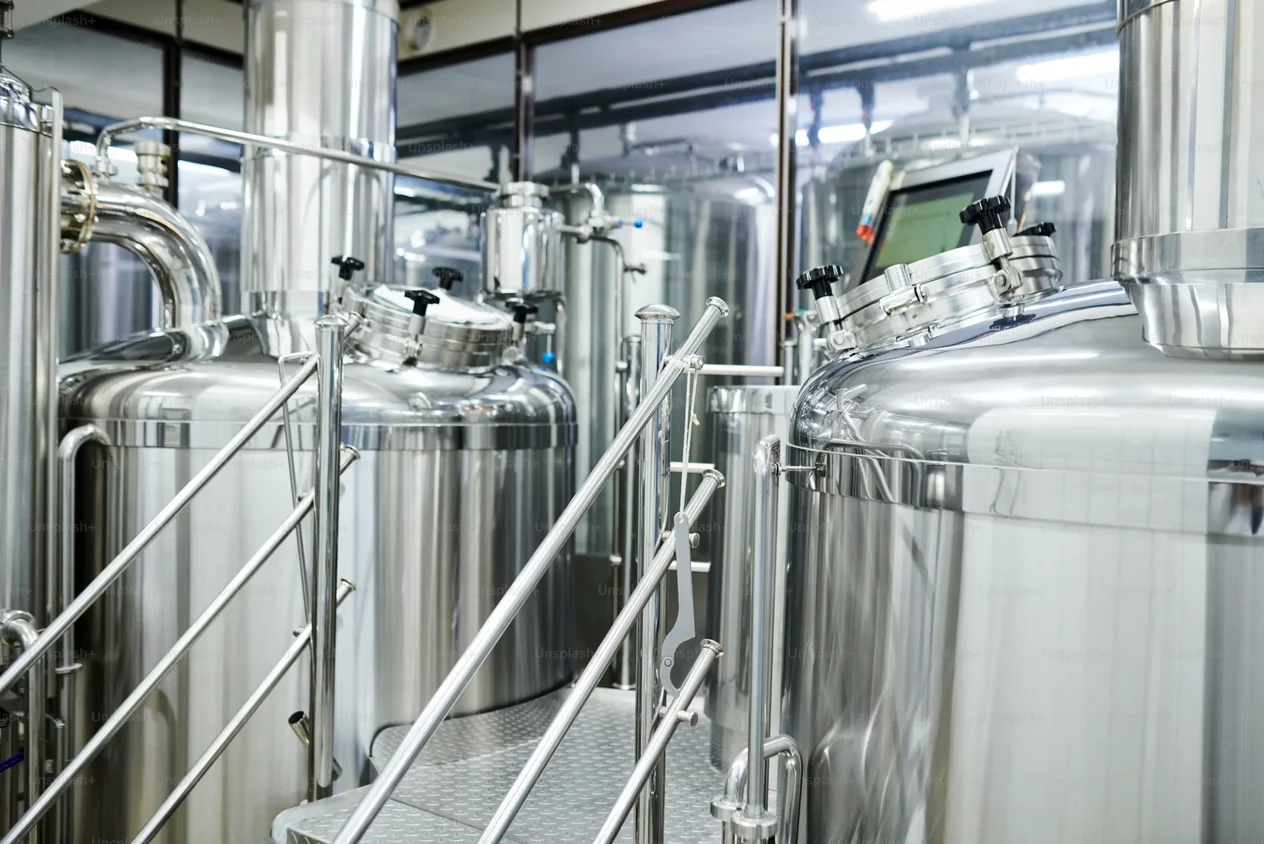
Surface finish requirements in a pharmaceutical context
Surface finish is a decisive technical variable. In pharma, surface roughness is expressed in Ra (arithmetic roughness, in microns). The lower the Ra, the smoother the surface and the harder it is for microorganisms to colonize.
Typical standards are:
- Ra less than or equal to 0.8 µm for product-contact surfaces (basic GMP standard)
- Ra less than or equal to 0.4 µm for high-criticality applications (biotech, sterile)
- Ra less than or equal to 0.25 µm for electropolished surfaces
Electropolishing is an electrochemical technique that removes microscopic asperities, enriches the surface with chromium and improves corrosion resistance. It is a step often required in modern pharmaceutical specifications, in addition to mechanical polishing.
Pharmaceutical-grade finishes compliant with each project's requirements can be achieved through brushing and polishing to the required levels. See the page dedicated to food-grade and pharmaceutical stainless steel for available finish details.
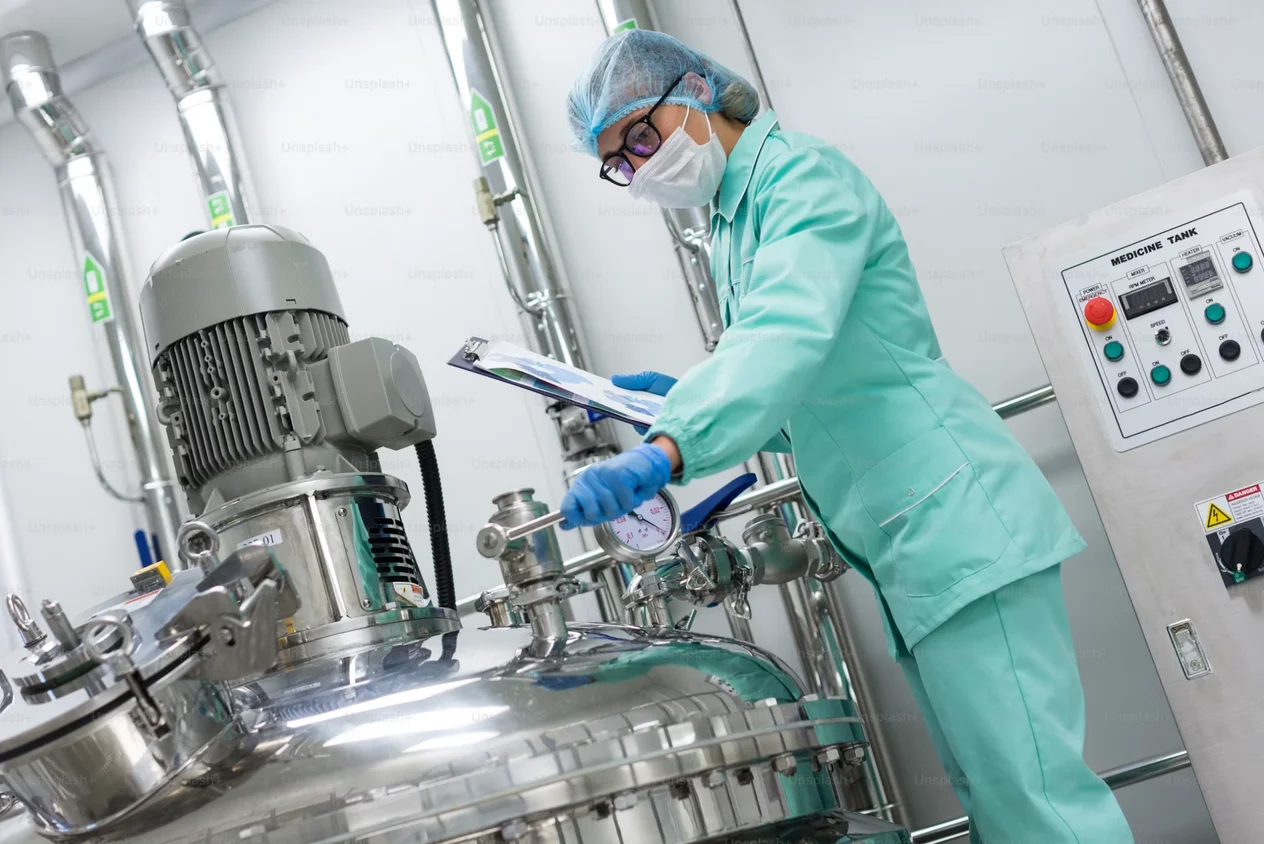
Types of equipment fabricated for the pharmaceutical sector
Metal fabrication needs vary depending on the stages of the pharmaceutical process. An integrated manufacturer can produce a wide range of custom components:
| Equipment type | Typical application |
|---|---|
| Mixing and storage vessels | Formulation, storage of active products |
| Pressure tanks | Fermentation processes, bioreactors |
| Structures and platforms | Access to production equipment |
| Piping and manifolds | Transfer of process fluids |
| Custom welded assemblies | Integration into existing lines |
| Hoods and containment enclosures | Operator and product protection |
Each component is fabricated according to plans provided by the client or developed jointly from a functional specification, with 3D modeling in SolidWorks or AutoCAD.
Request a feasibility assessment for your pharmaceutical equipment
Documentation, traceability and quality system
In pharma, the delivered part is never alone. It comes with a fabrication file that may include:
- Material certificates (mill certificates) confirming the chemical composition and mechanical properties of the metal used
- Welding reports with WPS (Welding Procedure Specification) parameters and PQR qualifications
- Dimensional inspection records with measured tolerances
- Ra roughness reports for critical surfaces
- Calibration certificates for the measuring equipment used
This level of documentation is made possible by an ISO 9001 certified quality management system, which imposes documented processes at every stage of production. ISO 9001 certification guarantees consistency and full traceability across all projects.
CWB Division 2 certification and what it guarantees
CWB (Canadian Welding Bureau) certification under the CSA W47.1 Division 2 standard is a serious prerequisite for any manufacturer working in demanding sectors. It attests that the company has qualified welders, validated welding procedures and a supervision system compliant with Canadian standards.
For a pharmaceutical client, this means in practical terms:
- Each welder is qualified on the processes and materials they use
- Welding parameters are documented and controlled
- Visual and non-destructive inspections (where required) are carried out according to defined protocols
- CWB documentation can be produced on request for inspection or quality audit
This certification is particularly relevant for vessels, tanks and pressurized assemblies subject to regulatory inspections. According to the CWB Group, certified companies are listed in a public register available online.
Conclusion
Stainless steel fabrication in the pharmaceutical industry requires a precise combination of material grade, surface finish, certified welding procedures and rigorous documentation. 316L remains the dominant standard for its chemical resistance and cleanability. CWB Division 2 and ISO 9001 certifications are not mere badges: they define the rigor of the production system.
Working with a local integrated manufacturer simplifies the approval chain and reduces delivery times. The Laval shop has been established since 1992 and delivers components compliant with the requirements of the pharmaceutical, food and water-treatment sectors.
Contact the technical team to discuss your next pharmaceutical project
FAQ
Which stainless steel grades are used in stainless steel fabrication in the pharmaceutical industry?
316L is the reference grade for pharmaceutical applications. Its molybdenum content makes it more resistant to cleaning agents and chlorides than 304L. Its low carbon content also reduces the risk of corrosion at weld joints, a critical point in GMP environments where surface cleanliness is checked regularly and documented in line with Good Manufacturing Practices.
What is the difference between mechanical polishing and electropolishing?
Mechanical polishing reduces surface roughness through progressive abrasion. Electropolishing is an electrochemical process that dissolves microscopic asperities and enriches the surface with passivated chromium. It produces a more uniform, more corrosion-resistant and easier-to-clean finish, which makes it the standard for surfaces in contact with active products in sterile or GMP environments.
What does CWB Division 2 certification imply for a pharmaceutical client?
CWB Division 2 certification under the CSA W47.1 standard means the manufacturer employs qualified welders, uses documented welding procedures and maintains a compliant supervision system. For a pharmaceutical client, this guarantees that welds on vessels, tanks and piping are made according to controlled parameters, with the documentation needed for internal and regulatory quality audits.
What documentation should a supplier provide on delivery of pharmaceutical equipment?
A serious supplier delivers material certificates, welding reports (WPS/PQR), dimensional inspection records, Ra roughness reports for critical surfaces, and calibration certificates for the measuring instruments. This documentation makes up the fabrication file required during quality audits and regulatory inspections in pharmaceutical and biopharmaceutical environments.