Stainless steel parts for pulp and paper must withstand abrasion, moisture and hot chlorinated agents. Paper mills favour austenitic grades such as 316 and, in aggressive chloride environments, duplex stainless steels, whose resistance to stress corrosion cracking exceeds that of standard grades.
In a mill, choosing stainless steel parts for pulp and paper is no trivial matter. A paper machine runs continuously, often for years, in an environment saturated with steam, abrasive pulp and chloride-laden liquors. A poorly selected component corrodes, cracks or wears out prematurely, and every unplanned shutdown is costly.
This industry guide explains why the paper industry is so aggressive toward metal, how to choose the right grade for each area of the machine, and which components benefit from custom fabrication. The goal is simple: extend the service life of your equipment while reducing the risk of downtime.
Why the paper industry is so hard on metal
Papermaking combines several forms of attack that are rarely found together elsewhere. Understanding these constraints is the first step toward specifying a durable component rather than a part that needs replacing every season.
Constant abrasion and mechanical wear
Pulp contains fibres, mineral fillers and sometimes hard particles that rub continuously against metal surfaces. Doctor blades, scrapers and guides are the first to be exposed. Without good abrasion resistance, the working edge dulls, performance drops and sheet quality deteriorates.
Moisture, steam and hot chlorinated agents
Process water, steam and bleaching liquors create a particularly corrosive hot chloride environment. It is the worst-case scenario for many stainless steels: the combination of chlorides and heat promotes pitting corrosion and stress corrosion cracking. Grade selection must therefore be based on the actual temperature and chloride content at each station.
Choosing the right stainless steel parts for pulp and paper
There is no universal grade. Best practice is to match the alloy to local conditions, as recommended by reference guides on corrosion resistance in industrial environments.
304 and 316, the basic austenitic grades
304 is suitable for dry or mildly corrosive areas, but it quickly reaches its limits once chlorides are present. 316 performs better thanks to its 2 to 3% molybdenum, which significantly improves pitting resistance. According to the Nickel Institute, 316L has become the main material of construction in many paper mills. It is often a reasonable starting point for 316 stainless steel in wet areas.
309 and duplex stainless steels for extreme conditions
When temperatures rise and chlorides become concentrated, standard austenitic grades become vulnerable to stress corrosion cracking. Duplex stainless steels, with their mixed ferrite-austenite structure, then perform much better. The Nickel Institute assesses this performance using the PREN (Cr + 3.3 Mo + 16 N) and sets the threshold for good resistance at 35 or higher. 309, with its higher chromium content, remains useful in the hot zones of certain processes.
The following table summarizes the main selection guidelines.
| Grade | Molybdenum | Chloride resistance | Typical uses |
|---|---|---|---|
| 304 | None | Low | Dry areas, structures, supports |
| 316 | 2 to 3% | Good | Wet areas, piping, tanks |
| 309 | None (high chromium) | Good at high temperature | High-temperature areas |
| Duplex | ≈ 3% | High | Aggressive chloride environments, digesters |
Key points to keep in mind before specifying a component:
- Start from actual conditions: temperature, chlorides, pH and level of abrasion.
- Reserve duplex for critical areas where stress corrosion cracking is a threat.
- Plan the surface finish, since it affects corrosion as much as the grade does.
- Document each station to standardize future replacements.
Equipment and doctor blades fabricated for mills
Beyond material selection, the value lies in the part itself. Paper mills order a wide range of metal components tailored to their machines.
- Abrasion-resistant doctor blades and doctor foils for roll cleaning.
- Stainless steel tanks, vessels and piping for process circuits.
- Expansion joints, ducts and structural parts.
- Custom replacement components for existing machines.
This metal equipment for the paper industry shares a common requirement: it must fit into installations that are often old, with no compromise on tolerances. That is where custom parts fabrication makes the difference, by tailoring each component to the station where it is used.
Planning to replace a critical component or a doctor blade project for your paper machine? Request a technical quote to confirm the right grade and finish for your operating conditions.
Custom fabrication and durability factors
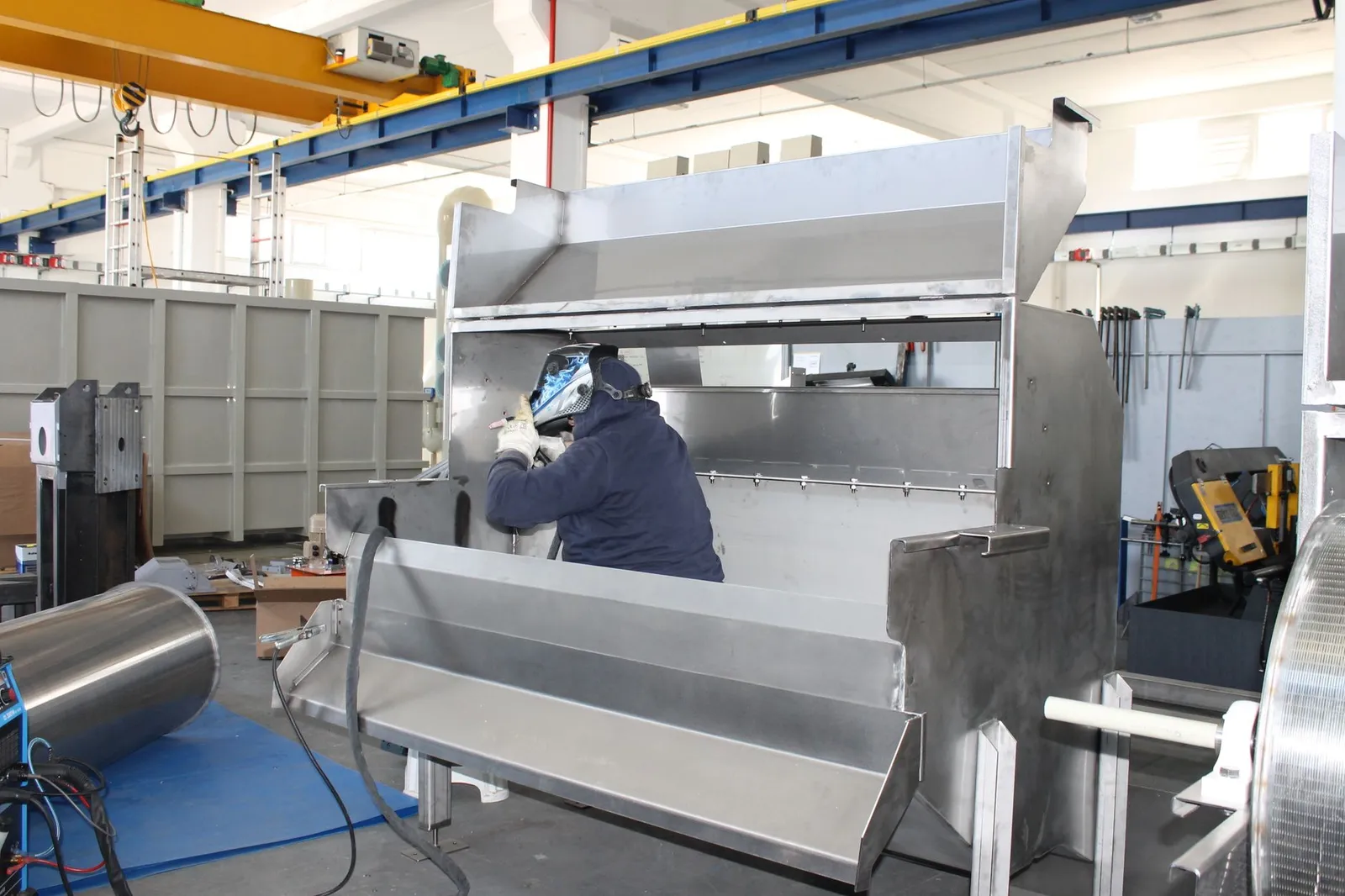
A durable component does not depend on the alloy alone. The fabrication process, finish and assembly quality determine actual performance in service.
Surface finish, an often underestimated factor
A smooth surface limits deposit buildup and reduces corrosion initiation sites. On parts exposed to liquors, a good stainless steel surface finish extends service life and makes cleaning easier. On a doctor blade, edge quality directly determines scraping performance.
Welding, assembly and quality control
Welded areas are sensitive points: a poorly executed weld can become a preferred site for corrosion. An ISO 9001 certified manufacturer qualified in welding manages these steps through documented procedures and rigorous inspection. For the paper industry, this traceability is both a guarantee of reliability and a safety requirement.
Custom metal components for the pulp and paper industry therefore bring together three decisions: grade, fabrication and finish. Each one affects abrasion resistance and performance in hot chloride environments, and therefore how often shutdowns occur. A partner who masters these solutions for the paper industry helps make the right trade-off from the design stage.
Conclusion
Properly specifying stainless steel parts for pulp and paper means matching the grade, fabrication and finish to the actual constraints of each station: abrasion, moisture and hot chloride environments. 316 often serves as the baseline, while duplex secures the most aggressive areas. This approach, backed by process data, reduces shutdowns and extends equipment life. Before starting fabrication, request a quote and an analysis of your operating conditions to confirm the right alloy and finish.
FAQ
Which grades should you choose for stainless steel parts for pulp and paper?
Choosing stainless steel parts for pulp and paper depends on temperature and chloride content. 316, thanks to its molybdenum, is suitable for many wet areas. In hot, aggressive chloride environments, where stress corrosion cracking threatens austenitic grades, duplex stainless steels offer greater security. An analysis of the process and liquors always guides the final selection of the appropriate grade.
Why is 316 not always enough in hot chloride environments?
316 resists general corrosion well thanks to its molybdenum, but it remains vulnerable to stress corrosion cracking when chlorides combine with high temperatures. Above a certain temperature threshold, standard austenitic grades can crack even at low concentrations. In these critical areas, a duplex stainless steel or a more highly alloyed grade becomes necessary to ensure equipment reliability.
What is a stainless steel doctor blade for the paper industry?
A doctor blade is a part mounted against a paper machine roll to scrape off pulp, water or deposits. Made from abrasion-resistant stainless steel, it is subjected to constant friction and contact with loaded liquids. Its grade and finish determine its service life. A well-designed doctor blade reduces shutdowns and protects the quality of the sheet produced.
Is custom fabrication necessary for these components?
Yes, in most cases. Paper machines are often old or one of a kind, and metal components must match existing dimensions to the millimetre. Custom fabrication makes it possible to adjust the grade, thickness, finish and tolerances to each station. It also makes it easier to quickly replace a worn part, which limits the length of costly production shutdowns at the mill.