There comes a point in the design of industrial equipment where 304L and 316L are no longer enough. Highly chlorinated environments, high temperatures, significant pressures, aggressive acidic conditions: some processes exceed the limits of these common grades. This is where duplex and super duplex stainless steels come in, with super duplex 2507 ranking among the highest-performing options available commercially.
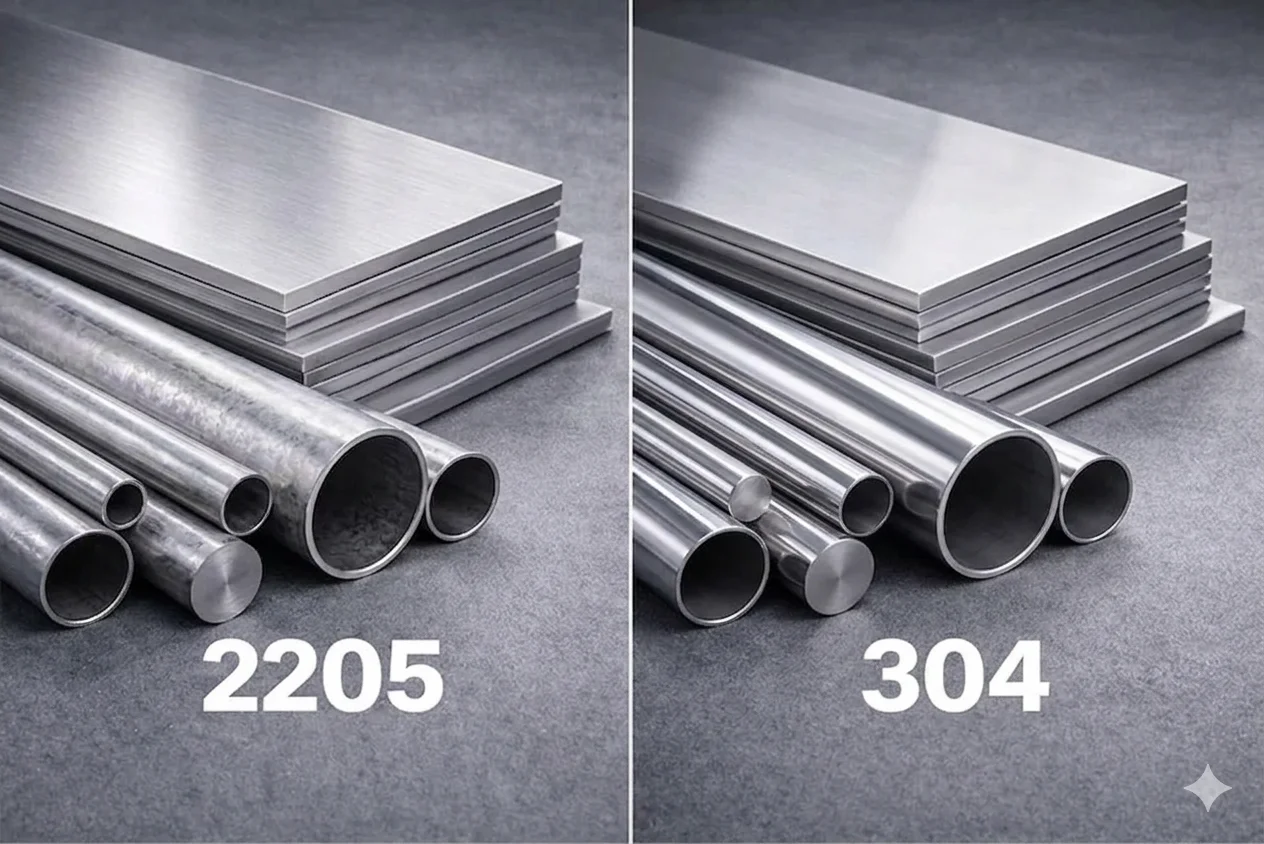
This article details the composition, properties and applications of duplex 2205 and super duplex 2507, with a practical look at how they are handled in industrial fabrication.
The duplex structure: austenite and ferrite combined
Conventional stainless steels such as 304L and 316L have a fully austenitic structure. Duplex grades, by contrast, combine roughly 50% austenite and 50% ferrite in their microstructure. This dual-phase makeup is not a compromise: it is a deliberate optimization.
The austenitic phase provides ductility, impact resistance and weldability. The ferritic phase contributes high mechanical strength and resistance to stress corrosion cracking (SCC). Together, they produce an alloy that outperforms austenitic grades on several key indicators, notably yield strength, which is about twice that of 316L.
For design engineers, this means wall thickness can be reduced without sacrificing mechanical performance, which can translate into material and weight savings on large equipment.
Duplex 2205: the versatile grade for severe environments
Duplex 2205 (UNS S32205 / S31803) is the most widely used duplex grade in industry. Its typical composition includes:
- Chromium: 22%
- Nickel: 5.5%
- Molybdenum: 3%
- Nitrogen: 0.17%
Its PREN (Pitting Resistance Equivalent Number), which measures resistance to pitting corrosion, sits around 35. That is markedly higher than 316L (PREN of about 24), making it suitable for environments containing chlorides at high concentrations.
2205 is used in a wide variety of industrial applications:
- Water-treatment equipment (dechlorination, reverse osmosis)
- Storage tanks for moderately concentrated acids
- Heat exchangers in marine or industrial settings
- Submerged structures in seawater
- Equipment in the pulp and paper industry
Duplex 2205 components are fabricated for clients in the water treatment and pulp and paper sectors, two environments where corrosion resistance is a primary design constraint.
Super duplex 2507: for the most aggressive conditions
Super duplex 2507 (UNS S32750) represents an even higher level of performance. Its composition is enriched:
- Chromium: 25%
- Nickel: 7%
- Molybdenum: 4%
- Nitrogen: 0.27%
Its PREN exceeds 40, making it one of the most pitting- and crevice-corrosion-resistant stainless steels available commercially. According to the IMOA (International Molybdenum Association), 2507 also offers superior resistance to chloride stress corrosion cracking (SCC), a particularly insidious failure mode because it develops with no visible sign until fracture.
Typical applications of super duplex 2507 include:
- Offshore and subsea equipment (oil platforms, desalination systems)
- Piping and exchangers in the chemical industry
- Equipment exposed to seawater at high temperature
- Components in high-pressure drinking-water treatment plants
- Applications in acidic environments with chlorides present
Consult a specialist to assess whether super duplex 2507 fits your application.
Comparison table: 316L, duplex 2205 and super duplex 2507
| Characteristic | 316L | Duplex 2205 | Super duplex 2507 |
|---|---|---|---|
| Structure | Austenitic | Duplex (50/50) | Duplex (50/50) |
| Yield strength (MPa) | ~170 | ~450 | ~550 |
| PREN | ~24 | ~35 | above 40 |
| Chloride SCC resistance | Moderate | Good | Excellent |
| Weldability | Excellent | Good (controlled) | Demanding |
| Relative cost | Baseline | about 1.5x 316L | about 2x 316L |
| Typical applications | Pharma, food | Water, pulp, light chemical | Offshore, aggressive chemical |
The higher cost of duplex grades is often offset by the possible reduction in thickness, the extended service life of the equipment and the reduction in corrosion-related maintenance costs.
Fabrication considerations for duplex grades
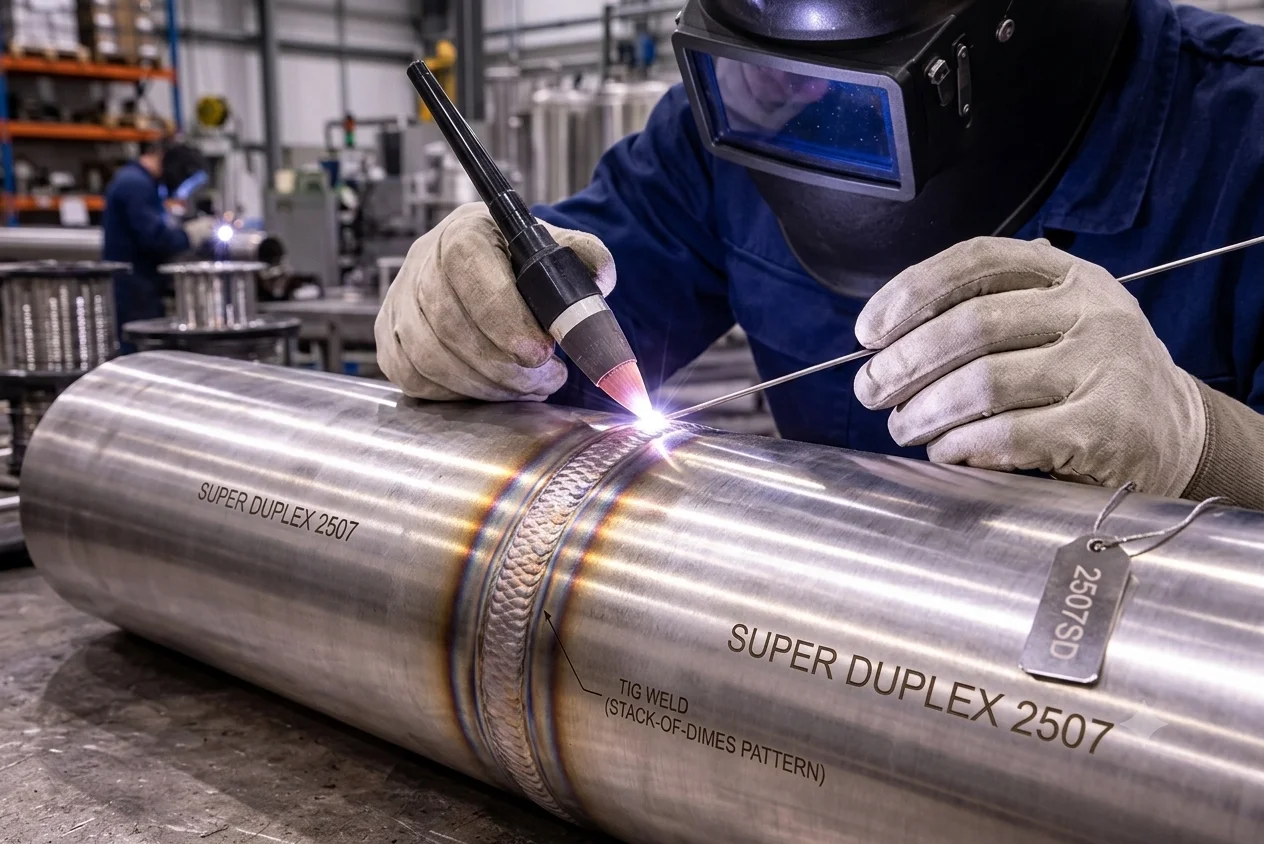
Welding duplex steels requires greater technical mastery than welding standard austenitic grades. Several parameters are critical:
- Heat input control: too high, it destabilizes the austenite-ferrite balance; too low, it can generate excessive ferrite or secondary-phase precipitates
- Suitable filler metal: the welding wire must be enriched with nickel to compensate for dilution and maintain the phase balance in the fusion zone
- Shielding gas: the use of nitrogen in the backing gas is often recommended to preserve austenite on the root side
- No standard post-weld heat treatment: unlike some steels, duplex grades must not be annealed after welding without specific precautions
These requirements make CWB Division 2 certification particularly important for duplex work. The shop holds this certification and the expertise to weld 2205 and 2507 according to qualified procedures, including for custom parts and stainless structures.
See the available materials page to view the full range of alloys, including Super Duplex 2205 and Super Duplex 2507.
Which grade to choose for your application
The choice between 316L, 2205 and 2507 depends on a combination of factors: chloride concentration of the environment, operating temperature, pressure, presence of acids, mechanical requirements and available budget.
A process engineer or materials specialist can calculate the required PREN and verify whether the candidate alloy will hold up under real service conditions. This approach avoids premature failures and costly replacements.
Conclusion
Duplex 2205 and super duplex 2507 are sound choices when standard austenitic steels reach their limits. Their two-phase structure gives them superior mechanical strength and corrosion resistance, at the cost of more demanding processing. These alloys are worked using CWB Division 2 certified procedures, which guarantees compliant components for the most demanding industries in Quebec and internationally.
Request a free quote for your duplex or super duplex 2507 project.
FAQ
What is the difference between super duplex 2507 and duplex 2205?
Super duplex 2507 contains more chromium (25%), molybdenum (4%) and nitrogen than duplex 2205, giving it a PREN above 40 versus about 35 for 2205. 2507 is recommended for the most aggressive environments, such as offshore settings with high chloride content or chemical processes containing concentrated acids. 2205 remains the standard duplex grade for the majority of severe industrial applications.
Can duplex 2205 and super duplex 2507 be welded with the same processes as 316L?
No. Duplex steels require strict control of heat input, specific filler metals and suitable shielding gases to maintain the austenite-ferrite balance in the welded zone. Heat input that is too high or too low can degrade the mechanical properties and corrosion resistance of the weld. These alloys require qualified procedures and welders experienced in a CWB-certified shop.
Is the higher cost of duplex grades justified in industrial fabrication?
In applications exposed to corrosive environments, yes. The superior resistance of duplex grades reduces the need for premature equipment replacement and corrosion-related production downtime. Their yield strength, twice that of 316L, also allows wall thicknesses to be reduced, which can partly offset the material premium, particularly on large or geometrically complex equipment.
Which industries use super duplex 2507 in Quebec?
Super duplex 2507 is used mainly in the water-treatment, industrial-chemical, pulp-and-paper and offshore sectors. In Quebec, municipal water-treatment plants and chemical-process facilities are the most common applications. Its resistance to corrosion in chloride-laden, high-pressure environments makes it the reference grade for critical, long-service-life components.