Two welds can have the same strength on paper and deliver very different results in the shop. One requires hours of grinding, the other slows down an entire production rate. The choice between MIG and TIG welding is often made before the drawings are even finalized, when the alloy, thickness and expected finish are set.
For an industrial buyer or an engineer, this decision affects cost per part, lead time, compliance and the final appearance of the assembly. A poorly suited process is paid for in rework, distortion or non-conformances.
This guide compares the two processes against concrete criteria, then offers a decision grid that applies to stainless steel, aluminum or carbon steel projects.
What sets MIG welding apart from TIG welding
MIG, a continuously fed wire electrode
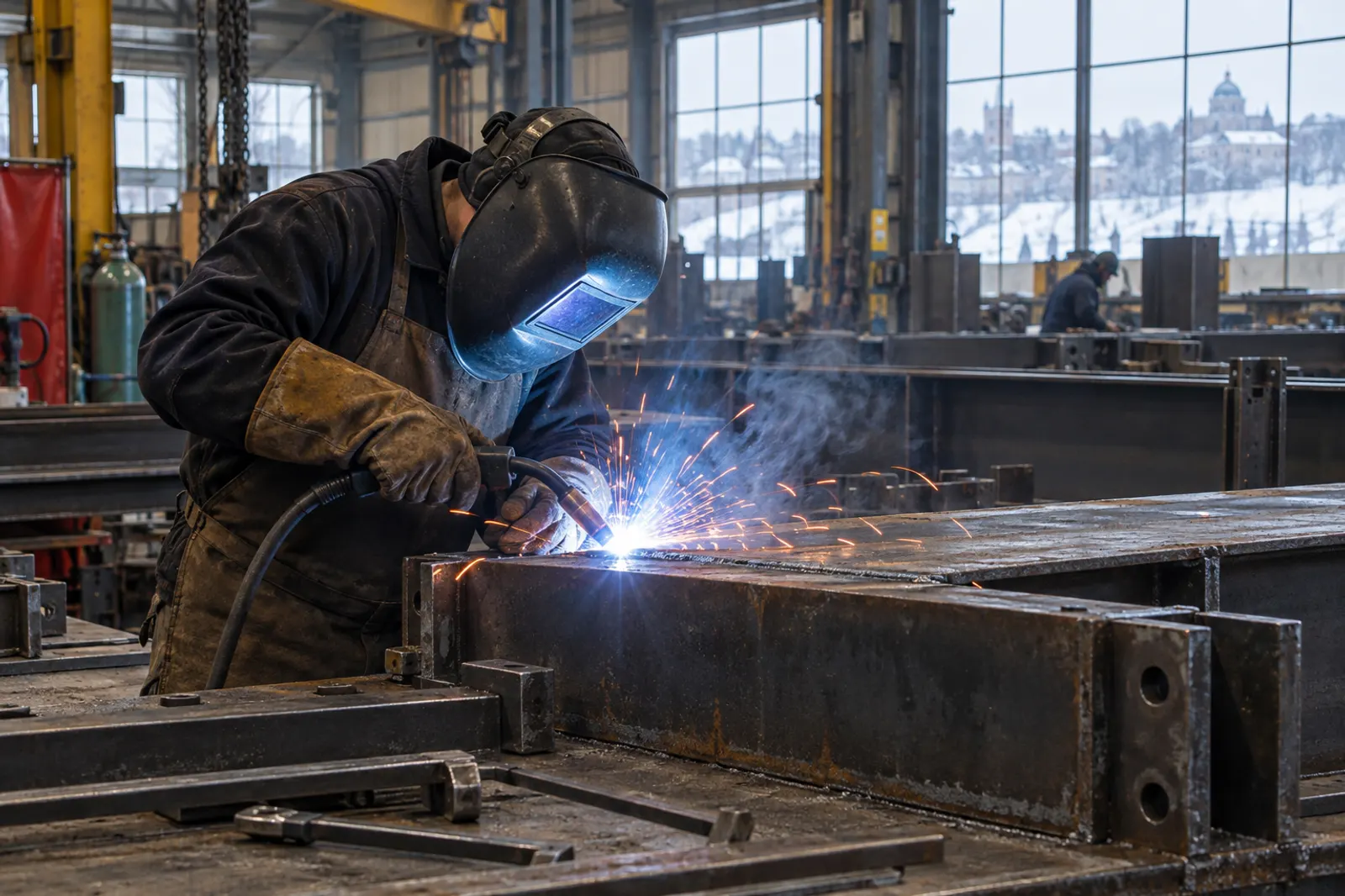
MIG welding, designated GMAW (gas metal arc welding) in North American standards, uses a consumable wire that serves as both the electrode and the filler metal. The wire is fed automatically through the gun, shielded by a gas or gas mixture.
The welder mainly controls travel speed, gun angle, and voltage and wire feed settings. This semi-automatic operation explains the process's high productivity on long welds.
TIG, a tungsten electrode and hand-fed filler
TIG welding, or GTAW, relies on a non-consumable tungsten electrode. Filler metal, when required, is added manually as a rod, independently of the arc.
This separation between the heat source and the filler gives the welder very fine control over the weld pool. In return, the process demands more coordination, often with a foot pedal to modulate amperage, and a slower pace.
TWI's comparison of the MIG and TIG processes sums up this trade-off well: MIG is faster and easier to master, while TIG produces more precise results.
The difference between MIG and TIG by fabrication criteria
The following table groups the differences that truly matter on a custom fabrication project.
| Criterion | MIG welding (GMAW) | TIG welding (GTAW) |
|---|---|---|
| Electrode | Continuously fed consumable wire | Non-consumable tungsten |
| Filler metal | Built into the wire | Rod added separately, or autogenous fusion |
| Speed and deposition rate | High | Low to moderate |
| Preferred thicknesses | Medium to thick sections | Thin sheet and precision parts |
| Bead appearance | Uniform, spatter possible | Fine and clean, no spatter |
| Heat input control | Moderate | Very fine |
| Skill required | Faster learning curve | High dexterity |
| Post-weld finishing | Frequent grinding on visible joints | Reduced finishing |
| Typical uses | Frames, supports, long welds, series production | Sanitary stainless, thin aluminum, titanium, exposed joints |
These differences do not make one process superior to the other. Rather, they show the context in which each becomes the most cost-effective and reliable.
When to favour TIG welding
Thin stainless steel and distortion-sensitive parts
Austenitic stainless steel, such as 304L or 316L, expands more and conducts heat less effectively than carbon steel. On thin-gauge sheet, poorly controlled heat input quickly causes warping.
TIG makes it possible to meter heat precisely, which limits the heat-affected zone and straightening rework. Fixturing and weld sequence nonetheless remain essential, as explained in this guide on custom welded metal assemblies and distortion control.
Sanitary, food and pharmaceutical applications
In equipment in contact with a product, the weld must be fully penetrated, smooth and free of crevices where residue could accumulate. TIG, combined with a back purge (gas shielding on the opposite side of the joint), limits root oxidation.
This root quality then makes polishing, pickling and passivation easier. The requirements specific to this sector are detailed in the article on stainless steel fabrication for food processing.
Aluminum, titanium and exposed joints
On aluminum, AC TIG helps break up the oxide layer while controlling the fusion of a highly conductive metal. The specifics of this work are explained in the article on TIG welding aluminum in an industrial setting.
Titanium, highly reactive when hot, also requires rigorous gas shielding, which TIG naturally provides. Finally, for a guardrail, a counter or a visible enclosure, a TIG weld reduces finishing time.
When MIG welding becomes the most productive choice
Thick sections and long welds
On thick plate, TIG requires multiple passes with a low deposition rate. MIG fills the joint faster, with fewer labour hours for the same volume of deposited metal.
Machine frames, equipment supports and secondary framing benefit especially from this efficiency, particularly when the joints are not exposed.
Productivity in industrial series welding
Continuous wire feed lends itself well to mechanization and robotics. For repetitive production, MIG offers a steady pace and a more predictable cost per part.
Quality then depends on parameter settings, bevel preparation and consistent fit-up of the parts before welding.
MIG welding on stainless steel, what you need to know
MIG works very well on stainless steel, provided a wire suited to the grade and an argon-rich shielding gas are used. Pulsed MIG reduces spatter and heat input, which makes it attractive for medium sections.
Heat tint must then be removed to restore corrosion resistance. The guide on stainless steel surface treatments covers pickling and passivation.
To confirm the best-suited process for a specific assembly, you can submit your drawings to a fabrication team before the quote is finalized.
Choosing the welding process for your part
A simple grid helps decide quickly between the two options:
- Thickness: thin sheet points to TIG, thick sections to MIG.
- Alloy: thin aluminum, titanium and sanitary stainless favour TIG. Carbon steel and structural stainless are welded efficiently with MIG.
- Production rate: a repetitive series or long welds justify MIG. Prototypes or one-off precision parts suit TIG.
- Aesthetic requirements: an exposed joint or one destined for a mirror polish benefits from TIG welding.
- Product contact: a food or pharmaceutical surface requires a clean, smooth root, and therefore generally TIG.
- Overall cost: welding time and finishing time must be added together, not just the former.
Combining both processes on the same assembly
The two methods are not mutually exclusive. On piping or thick plate, a TIG root pass followed by MIG fill combines quality and efficiency.
On a complete piece of equipment, the frame can be MIG welded while product-contact areas or visible joints are TIG welded. This split should be planned at the drawing stage.
Welding process certification and qualification
In Canada, the CSA W47.1 standard governs the certification of companies engaged in fusion welding of steel. According to the CSA W47.1 standard page from the Canadian Welding Bureau, it covers the qualification of welding engineers and supervisors, welder testing and procedure qualification.
Each welding procedure is tied to a specific process. A welder qualified in TIG is therefore not automatically qualified in MIG. Buyers should verify that the shop's certification covers the process planned for their part.
The points to check with a supplier are presented in the article on CWB-certified TIG welding and what B2B buyers verify.
Conclusion
TIG is the clear choice when precision, root cleanliness and bead appearance come first, particularly on thin stainless steel, aluminum and sanitary applications. MIG becomes more advantageous as soon as thickness, weld length or production volume take precedence.
The right decision accounts for alloy, thickness, production rate, aesthetic requirements and total cost including finishing. Ideally, it is made at the design stage, along with the choice of materials and tolerances.
To get a process recommendation tailored to a stainless steel or aluminum assembly, simply send the drawings and project requirements for a quote.
FAQ
MIG or TIG welding, which is stronger?
With MIG or TIG welding, strength depends first on the qualified procedure, the filler metal, penetration and the welder's skill. TIG is often associated with higher-quality joints thanks to its precise heat control. A well-executed MIG joint nevertheless remains fully suited to structural assemblies and the thick sections common in fabrication.
Can stainless steel be MIG welded?
Yes, stainless steel welds very well with MIG using a wire compatible with the grade, for example 308L or 316L, and an argon-rich shielding gas. Pulsed MIG reduces spatter and heat input. This process suits frames, supports and structural parts, while surfaces in contact with food products are generally TIG welded.
Why does TIG welding cost more than MIG welding?
TIG welding takes more time, because the filler metal is added by hand and the deposition rate remains low. It also requires highly experienced welders. This higher hourly cost is sometimes offset by reduced finishing, especially on exposed joints. It is therefore important to compare the total cost of the part, not just arc time.