Key takeaway: A stainless steel craft brewery tank is ordered starting from its function: brewing, fermentation, conditioning or serving. That function sets the working pressure, which can bring the tank under the RBQ regulation on pressure installations, and then the cone, the cooling, the vacuum protection and the fittings.
The batch has just been transferred to the conditioning tank. The emptied fermenter is still full of carbon dioxide, the crew closes it up and starts the caustic wash. Shortly after, the shell crumples like a can. What catalogues sell under the label "craft brewery stainless tank" is anything but a generic product.
Every tank in a brewery or distillery serves a specific function, pressure and cleaning method. Settling these in the right order avoids buying a fermenter that cannot carbonate, or a unitank that nobody had registered.
Every tank in the brewery has a role, and that role drives its design
In brief: the brewhouse heats and separates, the cellar ferments and conditions, and the buffer tanks store water between brews.
The word "tank" covers at least six pieces of equipment in a craft brewery, and each one is designed differently.
- The mash tun and the lauter tun. Mashing mixes the malt with hot water, then a false bottom separates the wort from the spent grain. They operate at atmospheric pressure, but carry the weight of the wet spent grain.
- The kettle and the whirlpool. The kettle brings the wort to a boil, then the whirlpool gathers the hop trub in the centre through a tangential inlet.
- The hot and cold liquor tanks. These are the brewhouse buffer tanks. Their volume is calculated from the number of brews run back to back in a day.
- The cylindroconical fermenter. Its cone collects the yeast and sediment at the end of fermentation.
- The unitank. This is a fermenter designed to hold enough pressure to carbonate and condition the beer in the same tank.
- The conditioning tank and the serving tank. Here the beer is clarified, carbonated and kept cold before canning or serving at the bar.
The containment basin under the caustic drums and the process water tank follow a different logic, with their own leak tests: they are covered in the article on custom stainless steel tanks.
Working pressure determines the tank category in Quebec
In brief: above low pressure, a unitank can become a regulated pressure vessel, with drawings signed by an engineer and registered with the RBQ.
A conventional fermenter operates close to atmospheric pressure. A unitank, on the other hand, holds carbon dioxide in the beer to carbonate it, which pushes its design pressure upward.
The threshold to know appears in the application guide for the Regulation respecting pressure installations published by the Régie du bâtiment du Québec in 2019. "Low pressure" stops there at 103 kPa (15 psi) for steam and gases. Whether a vessel is regulated is then determined using figures taken from the CSA B51 standard.
The American manufacturer Paul Mueller designs its standard fermenter at 14.9 psig, outside the ASME code, just under the 15 psi mark.
For a regulated vessel, section 30 requires plans and specifications signed by an engineer and registered with the Régie, a quality control program, an inspection and a declaration of conformity. Section 40 requires the welding procedure to be registered before the work, and section 31 requires the installation to be approved before commissioning, with some exceptions.
The practical consequence fits on one line of the specification. State the target working pressure and the relief valve setting, then ask in writing whether the tank is regulated. A supplier who hesitates on this question before pricing the project says a lot about what comes next.
The cone and the cooling zones follow the recipe
In brief: the cone angle governs yeast harvesting, and the number of glycol zones governs how fast the beer comes down in temperature.
The steeper the cone, the more the yeast slides toward the dump valve instead of clinging to the walls. Paul Mueller's standard fermenter uses a 70° cone, two cooling zones on the shell, a third on the cone and 3 in. of insulation.
The cone zone keeps the yeast cold at the bottom while the shell controls fermentation, and it helps with the final crash cooling.
A brewery focused on ales and another that conditions lagers do not have the same needs. Lager ferments colder and longer, so the jacket surface and the glycol chiller capacity are sized for it first.
Before detailing begins, specify whether the tank will sit in a cold room and how many tanks the chiller will bring down at the same time. These two answers set the insulation and the jacket, for a custom stainless fermenter as well as for an adapted standard model.
A tank must be protected from vacuum as much as from pressure
In brief: a fermenter full of carbon dioxide washed with caustic soda can implode if nothing lets air in.
Paul Mueller describes the scenario in its demonstration on implosion during caustic washing. After the transfer, the fermenter remains filled with carbon dioxide. The caustic soda reacts with this gas, the internal pressure drops, and a closed tank without a working vacuum breaker collapses.
The safeguards come down to three steps:
- Open the racking valve for the entire clean-in-place (CIP) cycle.
- Size the vacuum relief valve for the volume of the tank, not for that of the tank next to it.
- Maintain and operate it before every wash, since a seized valve protects nothing, whatever its size.
When ordering, require a combined pressure and vacuum relief valve with its setting marked, and have it operated in front of you at delivery.
Planning a cellar expansion or a tank replacement? Have your drawings reviewed before fabrication starts.
Welds, finish and fittings, where beer gets contaminated
In brief: bacteria settle first where the cleaning solution circulates poorly, in welds, fittings and valves.
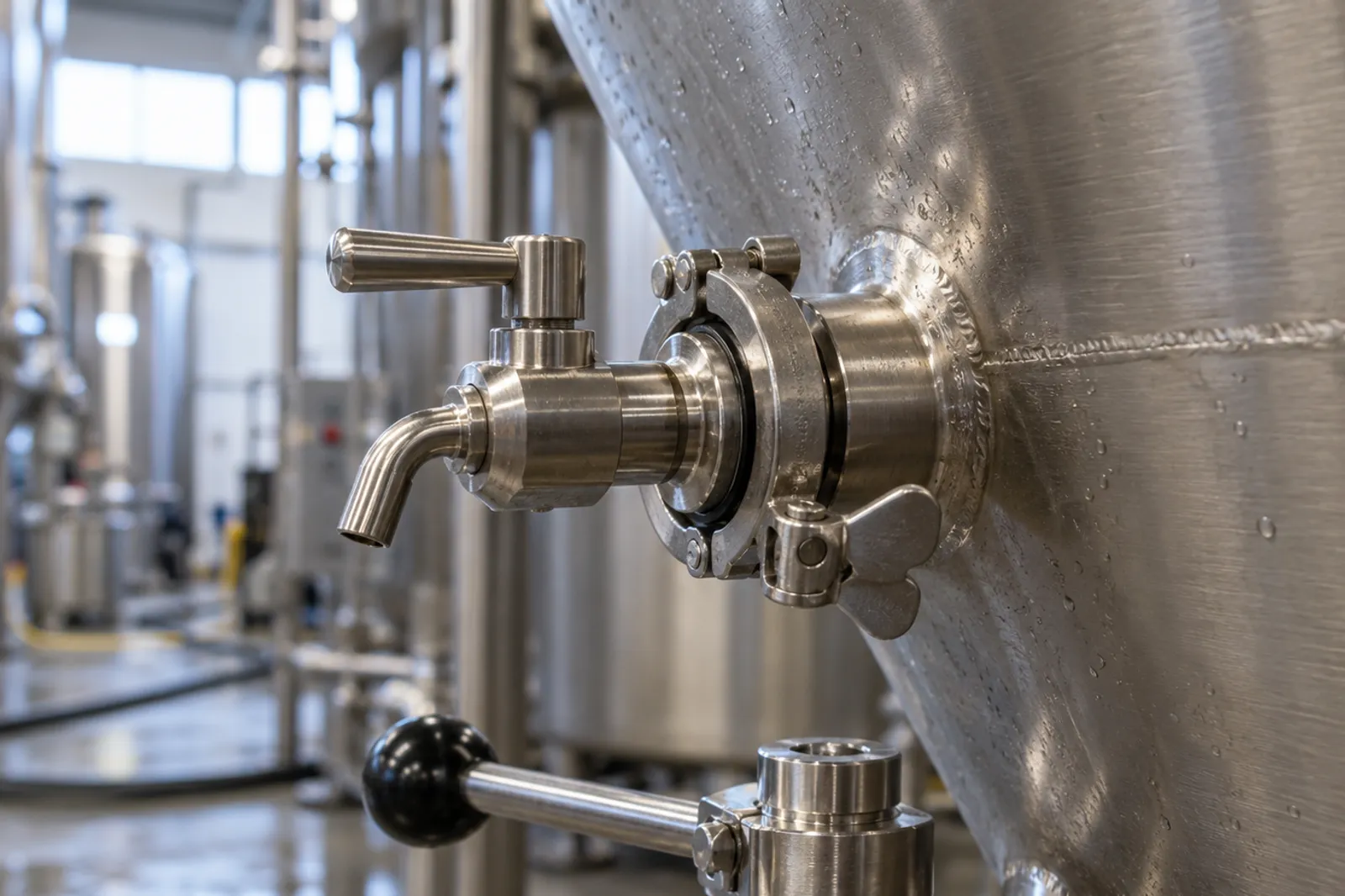
A large smooth wall cleans well. Problems come from a nozzle that is too long where the solution stagnates, a cracked manway gasket, a sampling valve taken apart once a year.
Internal welds must be full penetration and ground flush, done by TIG with backing gas on the root side. Welder and company qualification under CSA W47.1 is explained in the article on CWB-certified TIG welding. For the internal finish, the roughness benchmarks are the same as for sanitary finishes in food processing.
When a tank is delivered, before signing the delivery slip, these six points can be checked with a flashlight and by touch.
| Component | What to check | Warning sign |
|---|---|---|
| Internal welds | Continuous bead, ground flush, no discolouration | Raised bead, pitting, blued or browned root |
| Tri-clamp fittings | Ferrules welded flush with the wall | Recessed ferrule that forms a step |
| Spray ball | Wall fully wetted during a water test | Dry areas, especially under the manway |
| Sampling valve | Removable and easy to sanitize | Valve that cannot be opened for cleaning |
| Pressure and vacuum relief valve | Setting marked, moves freely | No setting marked |
| Manway | Gasket intact, door closes without forcing | Pinched or cracked gasket |
The right-hand column matters more than the middle one. A single one of these signs justifies a written reservation on the delivery slip.
Standardize the fittings from the start as well. A cellar that mixes 1 1/2 in. and 2 in. tri-clamps multiplies adapters, and every adapter adds two gaskets to clean.
In a distillery, stainless does the heavy lifting and copper shapes the flavour
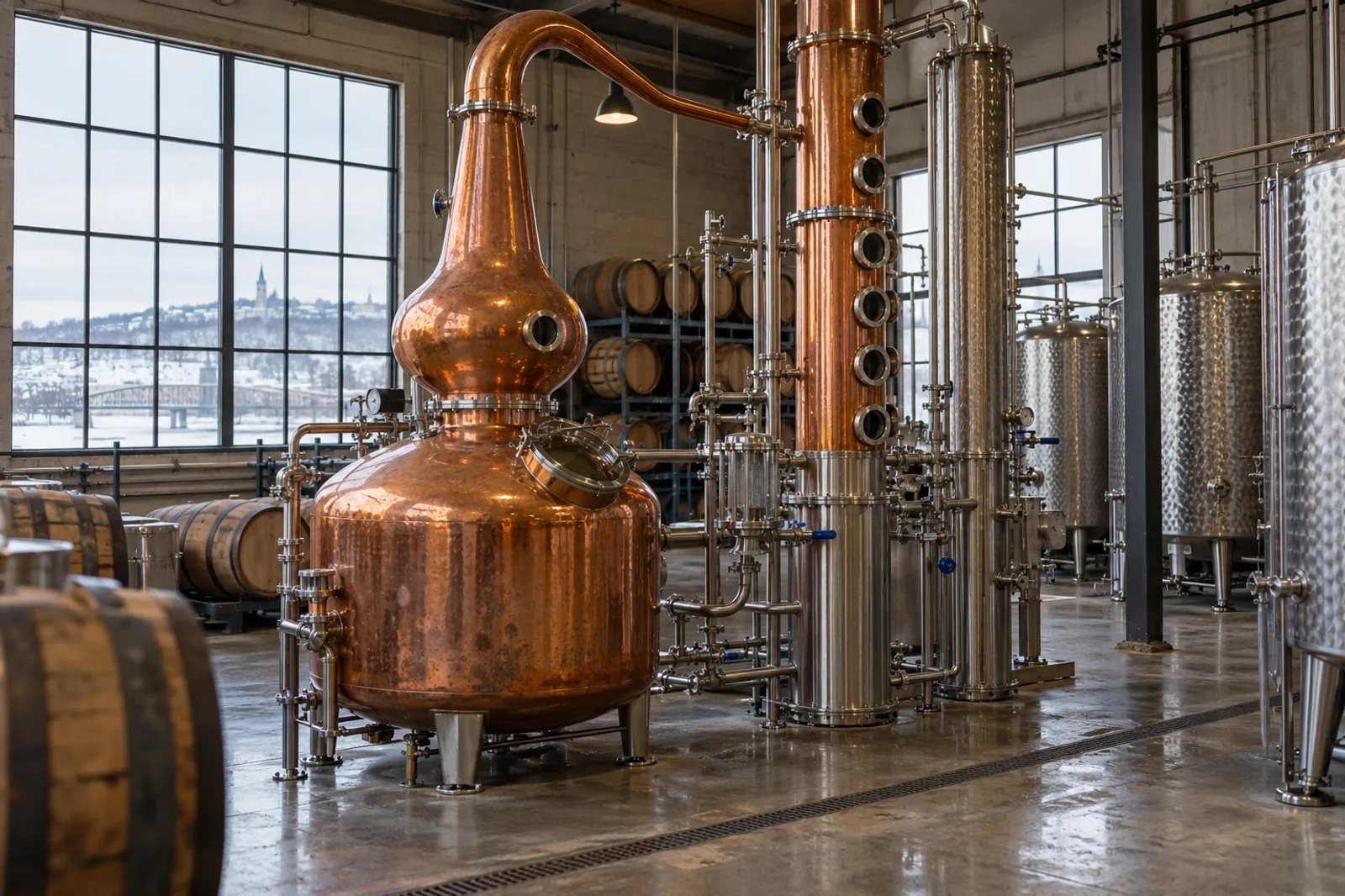
In brief: a distillery's stainless equipment covers the tanks, the cookers and often the still bodies, while copper is placed where it purifies the distillate.
Up to fermentation, a craft distillery raises the same questions as a brewery: cooling, cleaning, fittings.
The difference comes at the still. According to Craft Spirits & Distilling's analysis of stainless steel and copper, published in January 2026, stainless steel is used for tanks, mash cookers, pot and column stills, condensers and fittings. It resists ethanol and acidity, and it tolerates caustic soda. Copper, for its part, binds with sulphur compounds and removes them from the spirit.
This split weighs on fabrication. Caustic soda corrodes copper, and the same article recommends a mild alkaline cleaner followed by a citric acid solution instead. A CIP circuit shared by a stainless tank and a copper helmet must therefore be planned at the design stage, with valves that isolate the two metals.
The location of the copper matters too. With barley that contains glycosidic nitrile (GN), copper placed in a descending lyne arm or in the condenser can promote the formation of ethyl carbamate, which then ends up in the spirit. The boundary between stainless and copper is set at the drawing stage, not at assembly.
Conclusion
A well-ordered stainless steel brewery tank is decided in four steps: the function, then the pressure and its status with the RBQ, then the cone and the cooling, and finally the vacuum protection and the fittings. Reversing that order amounts to choosing a finish before knowing whether the tank must be registered.
Before requesting a quote, gather the working volume, the working pressure, the typical recipes, the tank location, the cleaning chemistry and the cellar's fitting standard. With these six pieces of information, a fabricator can propose a realistic design and a firm price. Send your tank drawings to get a quote.
FAQ
Does a stainless steel craft brewery tank need to be registered with the RBQ?
Not always. A stainless steel brewery tank operating at atmospheric pressure, such as a mash tun or a hot liquor tank, is not a pressure vessel. A unitank or conditioning tank designed to carbonate can exceed low pressure, set at 103 kPa for gases, and become subject to the RBQ regulation. Ask the manufacturer, in writing, for the status of each tank before ordering.
What is the difference between a fermenter and a unitank?
Pressure. A cylindroconical fermenter ferments the beer close to atmospheric pressure, then the beer moves to a conditioning tank to be carbonated. A unitank holds a higher pressure and lets you ferment, carbonate and condition the beer in the same tank. Its design and valves do cost more, however. Compare the two options against your projected annual volume.
Which stainless steel grade should be chosen for a brewing tank?
304L, in most cases. It stands up well to wort, beer and alkaline and acid cleaning cycles. 316L, which contains molybdenum, is justified when the brewing water is heavily chlorinated, or for sour beers aged over long periods. The choice is based on the municipal water analysis and on the cleaning chemistry used. Attach both to your request.
Does a still have to be made entirely of copper?
No. Copper reacts with the sulphur compounds formed during fermentation and removes them from the distillate, without having to make up the whole unit. Many distilleries combine a stainless steel still body or column, which is sturdier and easier to clean, with copper in the helmet, the lyne arm or the condenser. Set the exact location of the copper in the specification, before the still is drawn up.