A tank that leaks, corrodes prematurely or does not drain completely costs far more than its purchase price. Production shutdowns, product losses, non-conformities during an audit: the consequences affect the entire plant.
A custom stainless steel tank helps avoid these pitfalls, provided that the grade, geometry, welding and testing are designed around the contents and the process. Standard models rarely suit the space, connection or hygiene constraints of an existing installation.
This guide covers the equipment families, alloy selection, fabrication steps and the inspections to require, with a focus on process, food and water treatment applications.
Equipment covered by industrial tank fabrication
The term tank covers several pieces of equipment with distinct functions. Naming them correctly from the outset makes it easier to write the specification.
Storage tanks and process vessels
A stainless steel storage tank holds a liquid between two steps: process water, brine, syrup, chemical product or finished product. It generally operates at atmospheric pressure.
A process vessel, on the other hand, takes part in the transformation. It can be fitted with an agitator, a heating or cooling jacket, probes and clean-in-place (CIP) spray nozzles. Its design is therefore more demanding.
Bins, hoppers and tilting vessels
Open bins are used for soaking, washing or handling products. Hoppers, with their conical or pyramidal bottom, feed a conveyor or a bagging machine by gravity.
Tilting vessels make it easier to empty viscous products. Their pivot and frame must be sized for the weight of the contents in motion, not only at rest.
Stainless steel spill containment trays
A stainless steel containment tray collects leaks and spills under a tank, a pump or chemical containers. Its capacity, walls and welds must provide a complete seal, since it is the last barrier before the floor or the drain.
Choosing the stainless grade based on the contents
The contents determine the alloy, not the other way around. The following table presents general guidelines, to be validated according to concentration, temperature and the cleaning products used.
| Contents or environment | Grade generally considered | Point of attention |
|---|---|---|
| Drinking water, lightly chlorinated process water | 304L | Monitor chlorides and temperature |
| Food, dairy and beverage products | 304L or 316L | Chlorinated or acid cleaning, surface finish |
| Brines, wastewater, chlorinated water | 316L | Pitting risk in stagnant conditions |
| Seawater, high chlorides, aggressive processes | Duplex 2205 or super duplex 2507 | More demanding welding, higher cost |
| Pharmaceutical products | 316L | Documented traceability and roughness |
The differences between the two most common austenitic grades are detailed in the article 304L vs 316L, which stainless steel to choose. For chloride-laden environments, the guide on stainless steel corrosion resistance by environment provides useful benchmarks.
Steps in fabricating a custom stainless steel vessel
Design and drawings
The design sets the working volume, bottom geometry, nozzles, flanges, manway, supports and lifting points. A conical or sloped bottom promotes complete drainage, which is essential for effective cleaning.
3D modelling also makes it possible to check how the unit fits into the plant: clearances, maintenance access, passage through doorways and connection to existing piping.
Shell rolling and head forming
The shell is the cylindrical body of the tank. It is produced by rolling a cut plate on a plate roll to the target diameter, then welding the longitudinal seam.
Rolling accuracy determines the fit-up of the circumferential seams and the quality of the welds. The heads, whether flat, conical or dished, are formed separately and then joined to the shell.
Sanitary welding and interior finish
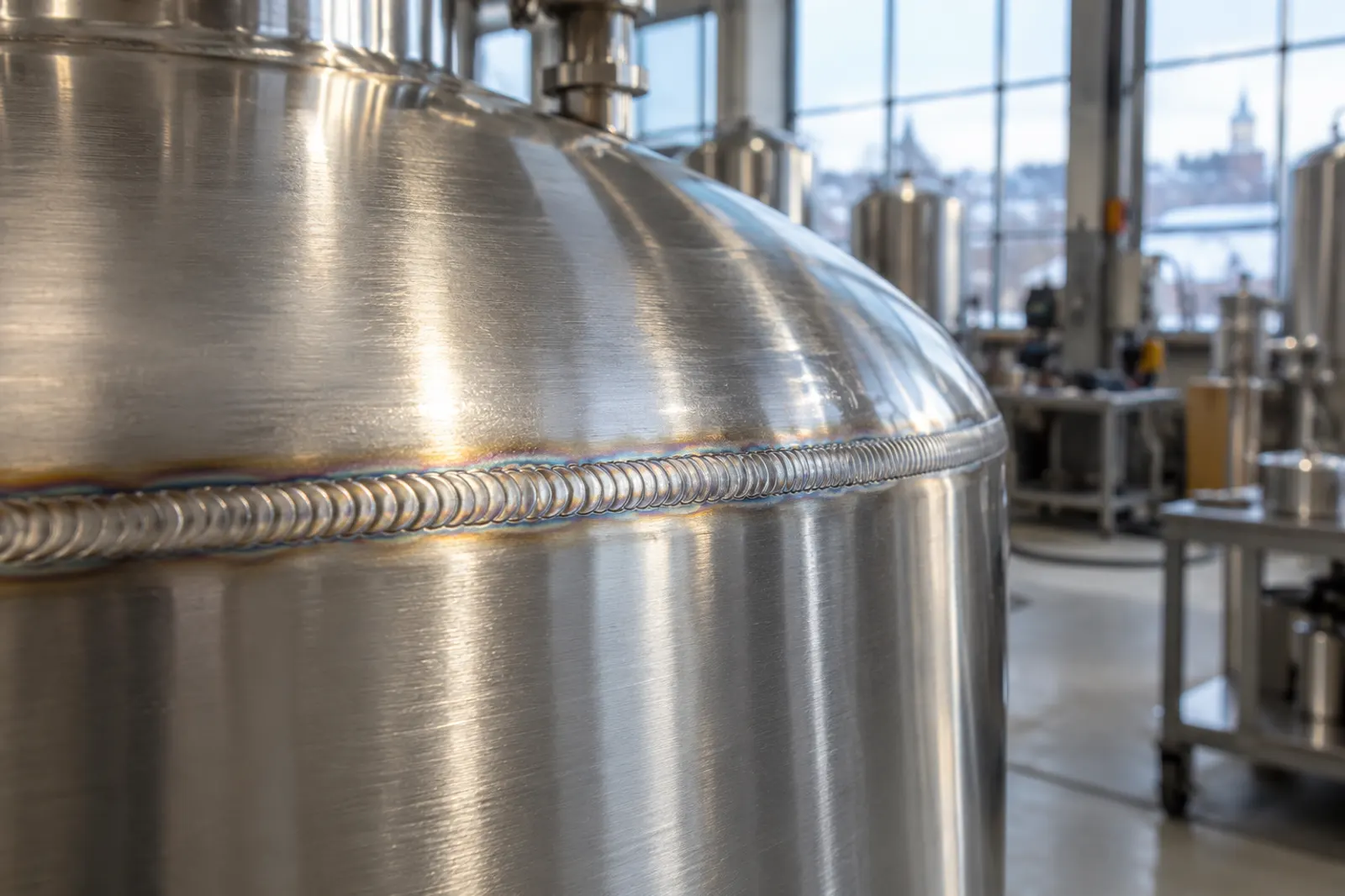
For food, pharmaceutical or drinking water service, interior welds must be full penetration, smooth and ground flush. TIG welding with back purging limits root oxidation and crevices.
Interior roughness is part of the specification. A University of Southampton review of stainless steel in the food industry notes that 3-A sanitary standards target a maximum roughness of 0.8 µm Ra for food contact surfaces.
Polishing, pickling and passivation complete the work. The sector's requirements are presented in the article on stainless steel fabrication for food processing.
To validate the grade, geometry or finish of a specific piece of equipment, you can have the drawings reviewed by a fabrication team.
Leak testing and inspections before delivery
A tank is only ready once its leak tightness has been demonstrated. Several methods complement one another depending on the design:
- Hydrostatic test: the tank is filled with water and held for the specified time, then inspected for any seepage.
- Dye penetrant testing: a penetrant liquid reveals surface-breaking cracks and porosity in the welds.
- Vacuum box: a vacuum box applied to a weld accessible from one side only, such as a bottom, reveals leaks through bubbles.
- Dimensional inspection: nozzle locations, plumb, leg levelness and conformity to drawings.
- Quality dossier: material certificates, welding procedures, test reports and roughness readings.
A tank designed to operate under pressure falls under a separate regulatory framework, notably the CSA B51 standard. This point must be clarified at the tender stage, since it changes the design, the documentation and the eligible supplier.
Requirements specific to process, food and water treatment
Food and pharmaceutical processing
Product contact surfaces must be smooth, drainable and easy to inspect. Rounded interior corners, the absence of dead zones and tri-clamp sanitary fittings make cleaning easier.
Traceability of materials and welds is often required during food safety or compliance audits.
Water treatment
In drinking water service, components in contact with the water, including tanks and welding consumables, may need to comply with NSF/ANSI/CAN 61. The NSF/ANSI/CAN 61 listing at the Standards Council of Canada specifies that its scope covers the contaminants these products may transfer to the water.
In wastewater, chlorides, hydrogen sulphide and permanently submerged zones often justify a 316L or duplex grade. The guide on stainless steel fabrication for water treatment details these choices.
Delivery and on-site installation
Road transport imposes width and height limits. A large tank can be delivered in one piece, in bolted sections or assembled on site, depending on its dimensions and access to the building.
During installation, levelling, anchoring to the floor, piping connections and the final commissioning test must be coordinated with the maintenance team or the mechanical contractor. Planning these steps in advance avoids costly rework on site.
Conclusion
A reliable custom stainless steel tank is the result of a series of consistent decisions: a grade suited to the contents, a geometry that drains completely, well-executed sanitary welds, documented leak tests and a planned installation.
Whether the need is for a process vessel, a stainless containment tray or a storage tank, the quality of the initial specification determines the outcome. The earlier the contents, temperature, cleaning method and installation constraints are defined, the more accurate the fabrication.
To obtain a technical assessment and a price, simply send the drawings or a description of the tank for a quote.
FAQ
How long does it take to fabricate a custom stainless steel tank?
The lead time for a custom stainless steel tank depends on its size, grade, plate availability, level of finish and the tests required. A small, simple vessel can be fabricated faster than a process tank with a jacket, agitator and sanitary polish. Drawing approval and material procurement often weigh as much as the fabrication itself.
What is the difference between a vessel and a stainless steel tank?
A tank is mainly used to store a liquid between two steps, generally at atmospheric pressure. A vessel takes part in the process instead: mixing, heating, cooling, fermentation or cleaning. It therefore often includes an agitator, a jacket, probes or clean-in-place spray nozzles. In everyday use in Quebec, however, buyers often use the two terms interchangeably.
What is a stainless steel containment tray used for?
A stainless steel containment tray collects leaks and spills under a tank, a pump or chemical containers. It protects the floor, drains and the environment in the event of a failure. Stainless steel is chosen for its corrosion resistance and ease of cleaning, particularly in food environments. Its capacity must be matched to the volume to be contained.