In a plant, the most critical equipment is rarely located at floor level. Valves, motors, hoppers and instruments require regular access, often at height and in confined spaces.
A poorly designed industrial metal staircase slows down maintenance, exposes workers to falls and can lead to costly corrections after an inspection. Conversely, a well-planned access structure integrates with the installation and lasts as long as it does.
This guide covers stairs, catwalks, platforms and mezzanines: regulatory requirements, loads, the choice of slip-resistant surfaces, sectional fabrication and on-site installation.
Industrial access structures and their uses
Each industrial access structure meets a specific need for circulation or work. The following table summarizes the main families.
| Structure | Main use | Key components |
|---|---|---|
| Industrial staircase | Permanently connect two levels | Stringers, treads, landings, handrails, guardrails |
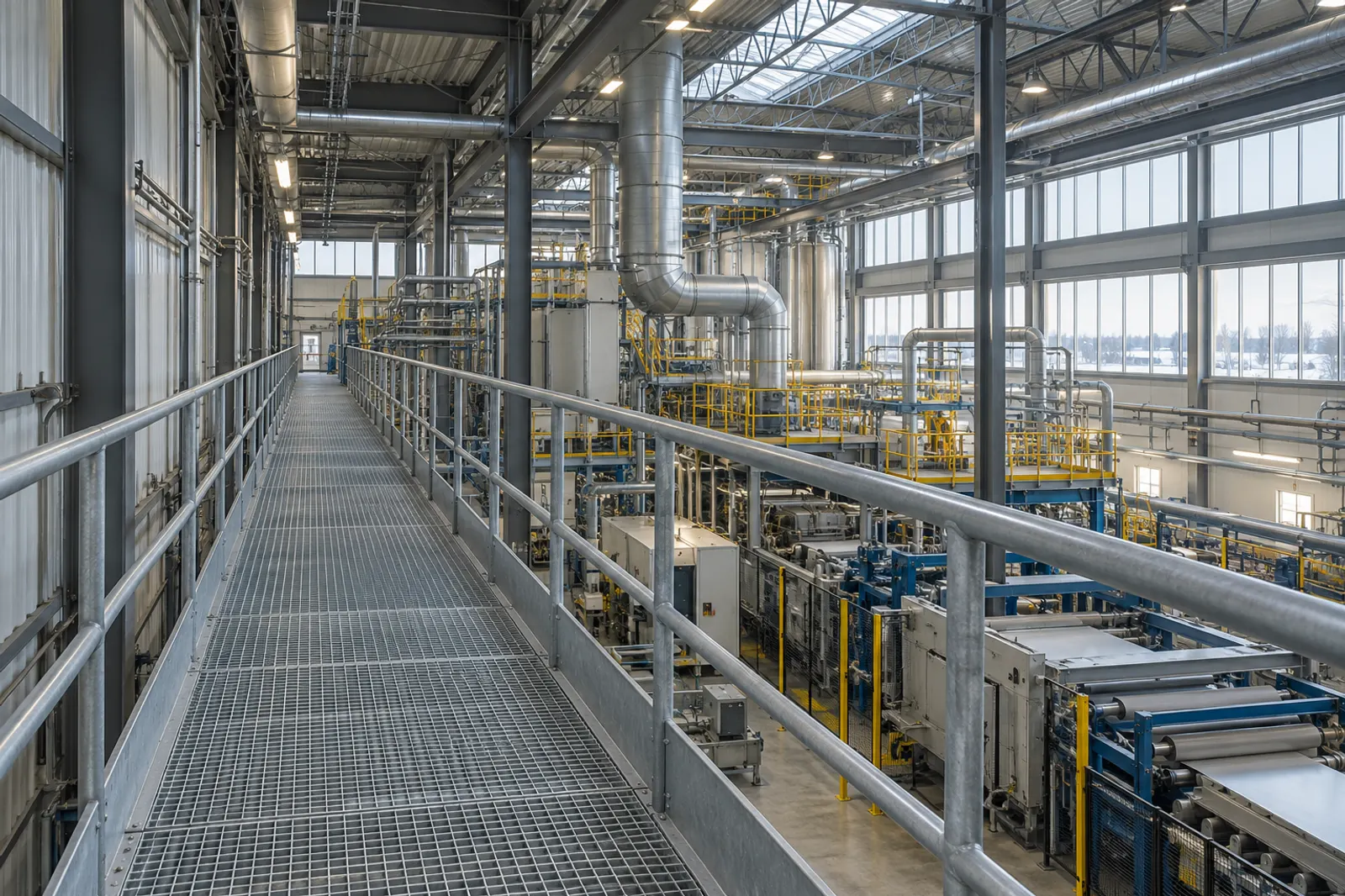
| Industrial catwalk | Travel above equipment or conveyors | Flooring, guardrails, toe boards, supports |
| Access platform | Work or perform maintenance at height | Work surface, guardrails, access by stair or ladder |
| Industrial mezzanine | Create additional floor space | Columns, beams, flooring, access stair |
A single installation often combines several of these elements, for example a platform around a tank connected to a catwalk and served by a staircase.
Code compliance and regulatory requirements
Construction code and occupational health and safety
In Quebec, stairs and guardrails built into a building are governed by the Building chapter of the Construction Code, which is based on the National Building Code. The NRC document on the Quebec Construction Code, Chapter I, Building presents this edition and the amendments specific to Quebec.
In the workplace, the Regulation respecting occupational health and safety adds its own requirements, particularly for guardrails and means of access. Access to machinery can also be designed according to the ISO 14122 series of standards.
Stair geometry and handrails
Riser height, tread depth, clear width, landings and guardrail height must meet the applicable requirements. Consistent riser heights are essential, since a single irregularity is enough to cause a misstep.
The CCOHS document on preventing falls on stairs points out that most falls on stairs result from a loss of balance, hence the importance of handrails, lighting and uniform dimensions.
The guide on custom stainless steel guardrails details the choice of grades, fasteners and finishes.
Allowable loads and structural design
Distributed loads and concentrated loads
A custom industrial platform must support people, but also tools, spare parts, carts and sometimes permanently installed equipment. Distributed loads and concentrated loads are defined according to the intended use.
Vibrations transmitted by nearby machinery, snow or wind loads outdoors and forces on guardrails must also be taken into account.
The role of the engineer and the drawings
In most projects, the structural design is carried out or validated by an engineer. The drawings specify the sections, connections, anchors and design loads.
3D modelling facilitates coordination with existing equipment and the detection of interferences before fabrication. This step is described in the article on 3D modelling of metal parts.
Grating and slip-resistant surfaces
The choice of flooring depends on the environment, the traffic and the cleaning requirements:
- Welded grating: a grid of bearing bars and cross bars that lets water, snow and debris through. It is the most common solution for catwalks.
- Serrated grating: notched bearing bars that improve grip in the presence of oil, water or ice.
- Checker plate: a solid surface with a raised pattern, useful when nothing must fall to the level below.
- Slip-resistant perforated plank: sections with punched perforations that provide high traction and efficient drainage.
- Slip-resistant stair nosing: a contrasting strip on the edge of each tread to improve visibility and footing.
In food plants, surfaces must also be easy to clean, which often points toward stainless steel and crevice-free details.
To determine the type of flooring and the grade suited to an installation, you can submit the drawings and site constraints to a fabrication team.
Choosing the material for the environment
An industrial catwalk in galvanized carbon steel is suitable for many dry or outdoor environments. Where there is frequent washdown, chemicals or sanitary requirements, 304L or 316L stainless steel becomes more durable.
Aluminum, being lighter, makes small structures easier to handle and install, but its lower stiffness must be compensated for in the design. The stainless steel vs aluminum comparison for engineers helps weigh these two options.
Protecting the structure against corrosion
Surface treatment extends the service life of the structure. Carbon steel is generally hot-dip galvanized after fabrication, which also protects the inside of hollow sections. Industrial paint can be added for safety marking or appearance.
Stainless steel, for its part, must have weld discoloration removed by pickling, then be passivated to restore its protective layer. Fasteners must be compatible with the structure's material to avoid galvanic corrosion between dissimilar metals.
Sectional fabrication and on-site installation
Dividing the structure for shipping
A steel industrial mezzanine or a long catwalk does not travel in one piece. The structure is divided into sections that fit within road transport limits and the building's openings.
Joints between sections are generally bolted, which speeds up erection and limits field welding. Trial assembly in the shop makes it possible to check hole alignment before delivery.
Installing without stopping production
On-site installation includes anchoring to the floor or existing structure, levelling, bolting and installing the guardrails. It is often scheduled during a maintenance shutdown.
Clear part marking, an established erection sequence and coordination with the other trades reduce the time spent on site. The related capabilities are presented on the custom stainless steel structures page.
Conclusion
A successful industrial metal staircase, catwalk or platform depends on a few decisive choices: compliance with applicable codes, well-defined loads, flooring suited to the environment, a durable material and fabrication designed for shipping and installation.
These elements are much easier to settle at the drawing stage than once the structure has been delivered. The project examples presented in the article on stainless steel structures for architecture and industry illustrate this approach.
To obtain a technical assessment and a price, simply send the drawings or a description of the access structure for a quote.
FAQ
Which standards apply to an industrial metal staircase?
In Quebec, an industrial metal staircase built into a building must comply with the Building chapter of the Construction Code, which is based on the National Building Code. In the workplace, the Regulation respecting occupational health and safety also applies, particularly for guardrails. Access to machinery can also follow the ISO 14122 standard. An engineer confirms the applicable requirements.
What is the difference between an industrial catwalk and an industrial platform?
A catwalk is mainly used to travel from one point to another, for example above a conveyor or between two pieces of equipment. A platform serves instead as a work surface at height, around a machine, a tank or a valve. Both require guardrails and slip-resistant flooring, but their design loads and dimensions differ according to the intended use and the equipment served.
Should you choose stainless or galvanized steel for a catwalk?
Galvanized steel is suitable for most dry or outdoor environments and has a lower initial cost. Stainless steel becomes preferable where there is frequent washdown, chemicals, chlorides or sanitary requirements, as in food or pharmaceutical processing. The right choice therefore depends on the environment, the cleaning frequency and the intended service life of the structure.