Two parts cut from the same plate can differ in cost by a factor of two, simply because the process was not suited to the thickness or the level of precision required. The choice of cutting technology carries through to bending, welding, finishing and lead time.
Plasma cutting of steel and fiber laser cutting are two of the most widely used thermal processes in metal fabrication. Yet they are not aimed at the same parts, nor at the same tolerances.
This comparison covers the thickness ranges, cut and edge quality, speed, cost and suitable materials for each, then offers a simple decision grid.
How plasma and fiber laser cutting work
Plasma cutting
Plasma uses an electric arc constricted in a nozzle that ionizes a gas, often compressed air, nitrogen or an argon-hydrogen mixture. According to TWI's overview of plasma cutting, this ionized gas jet exceeds 20,000 °C, melting the metal and blowing it out of the kerf.
The process only works on electrically conductive materials: carbon steel, stainless steel, aluminum, nickel alloys and titanium. The torch, mounted on a CNC table, follows the programmed contour.
Fiber laser cutting
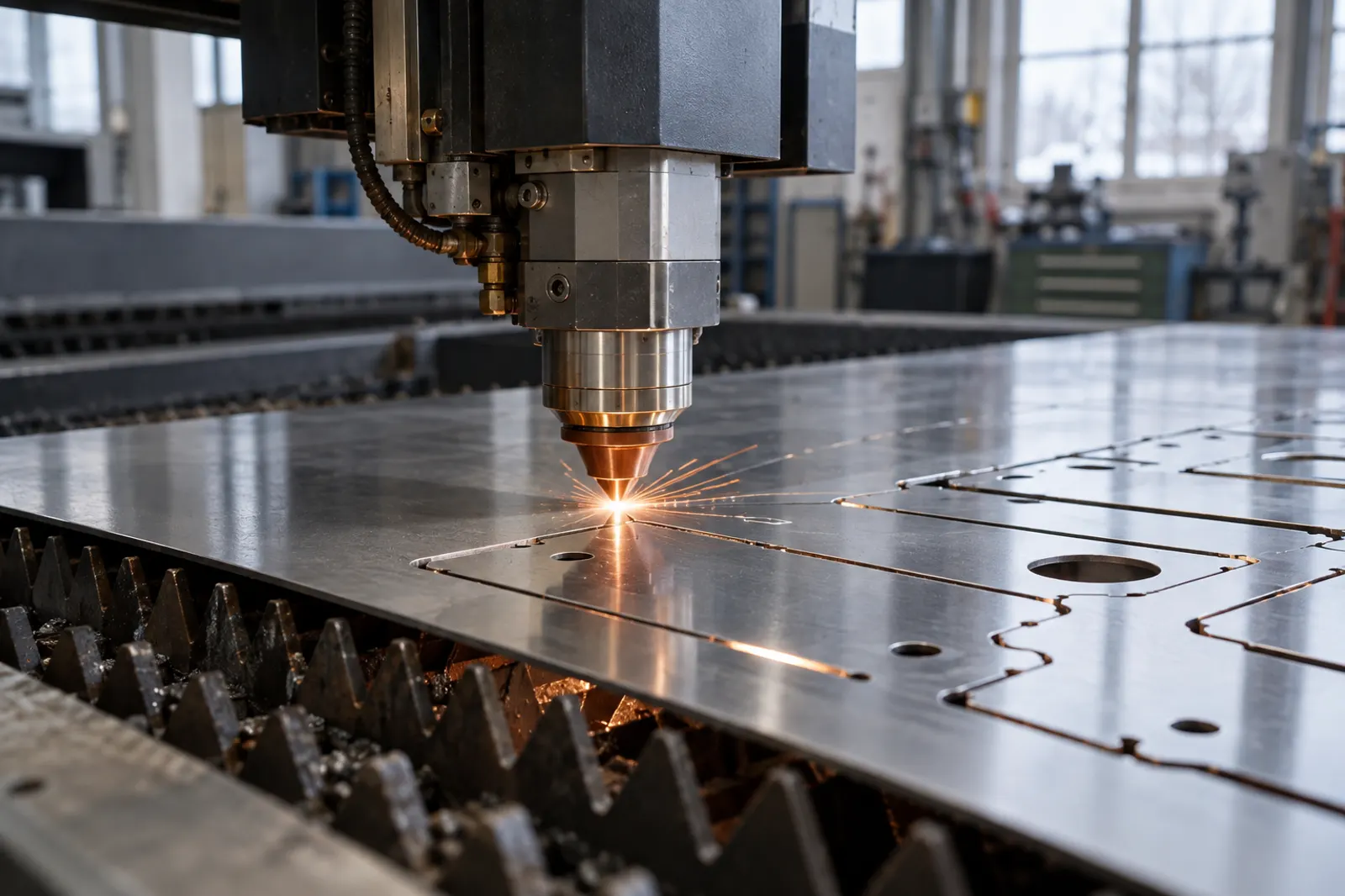
A fiber laser focuses a light beam of very high energy density onto a tiny spot. An assist gas, usually oxygen or nitrogen, clears away the molten metal.
The very narrow kerf and small heated zone allow fine contours, small holes and tight tolerances. Capabilities depend on the power of the source, as explained in the article on 4000W fiber laser cutting of stainless steel.
Plasma vs laser, the criteria that make the difference
The following table compares the two processes on the criteria that matter to a buyer or an engineer.
| Criterion | Plasma cutting | Fiber laser cutting |
|---|---|---|
| Materials | Conductive metals only | Metals, depending on power and gas |
| Sweet spot | Medium to thick plate | Thin to medium sheet |
| Kerf width | Wider | Very narrow |
| Edge squareness | Slight bevel possible | Square edge |
| Burrs and dross | Common, deburring often required | Minimal with proper parameters |
| Heat-affected zone | Larger | Very small |
| Small holes and fine detail | Limited | Excellent |
| Equipment cost | Lower | Higher |
| Cost per part | Favourable on thick plate | Favourable on thin sheet and complex contours |
TWI provides a comparison of the principal thermal cutting processes that confirms these trends: a kerf of around 0.1 mm and minimal distortion for laser, a wide range of materials and low consumable costs for air plasma.
Plasma vs laser cutting by thickness
Thin sheet and precision
On thin-gauge sheet and medium thicknesses, the fiber laser dominates. It cuts quickly, produces a clean edge and limits distortion, which simplifies CNC bending and fit-up before welding.
High-definition plasma improves precision on moderate thicknesses. TWI describes it as a cost-effective alternative to laser below 12 mm, though it does not reach the same level of fine detail.
Cutting thick plate
As thickness increases, laser speed drops and edge quality becomes harder to maintain. Plasma then keeps up a good pace at a reasonable operating cost.
For very thick carbon steel, oxy-fuel cutting also remains an option. When heat must be avoided, abrasive waterjet cutting takes over.
Cut and edge quality, the impact on downstream fabrication
Edge quality directly affects the following steps:
- Welding: a square, clean edge reduces bevel preparation and promotes consistent penetration.
- Bending: an accurate contour ensures repeatable dimensions after the press brake.
- Painting and finishing: plasma dross and burrs must be ground off before coating or polishing.
- Stainless steel corrosion resistance: nitrogen-assisted laser cutting leaves an oxide-free edge, useful for sanitary parts.
- Assembly: accurately cut holes eliminate secondary drilling or reaming.
The guide to custom CNC metal bending and cutting shows how these operations flow together in the shop.
To find out which process suits a specific part, you can have your drawings reviewed by a fabrication team.
Materials suited to plasma and laser
Carbon steel
Carbon steel cuts well with both processes. With laser, oxygen as the assist gas speeds up cutting on medium thicknesses, at the cost of a thin oxide layer on the edge. With plasma, it remains the material of choice for thick structural plate.
Stainless steel
On stainless, nitrogen-assisted laser cutting produces a bright, oxide-free edge ready for welding or polishing. A plasma-cut edge generally needs preparation before sanitary welding or an exposed finish.
Aluminum and other alloys
Aluminum can be cut by plasma or by fiber laser, but its high thermal conductivity and reflectivity call for adapted parameters. For titanium and nickel alloys, the laser's smaller heat-affected zone is often an advantage.
Cost of plasma and laser cutting
The true cost of a cut part goes beyond the machine's hourly rate. It includes programming, nesting parts on the plate, cutting time, piercing, deburring and rework.
On thick plate with simple contours, plasma often delivers the lowest cost per part. On thin sheet with many holes and details, laser becomes more economical, because its speed and clean edge reduce secondary operations.
Volume matters too. Optimized nesting on a repeat batch reduces material waste, an important factor with stainless steel, given its high price per kilogram.
Plasma vs fiber laser decision grid
Plasma is the right fit when
The part is thick, its contours are simple and its tolerances are loose. This applies to gussets, base plates, mounting tabs and structural parts that will be ground or welded afterwards.
Fiber laser is the right fit when
The part is thin or of medium thickness and includes holes, notches or fine details. Sheet metal parts, panels, equipment brackets and sanitary stainless components are good examples.
Typical thickness and tolerance capabilities are summarized in the article on custom industrial sheet metal.
Conclusion
Plasma cutting of steel remains effective for thick plate, simple contours and tight budgets. The fiber laser is the clear choice for thin to medium sheet, fine details and parts that require a clean edge before bending, welding or polishing.
The right choice depends on thickness, material, tolerances, volume and the operations that will follow the cut. By comparing total cost rather than machine time alone, the decision becomes much simpler.
To get a process recommendation and a price, simply send your drawings or DXF files for a quote. Capabilities are also detailed on the laser cutting service page.
FAQ
What thickness of steel can be cut with plasma?
Plasma cutting of steel covers a wide range of thicknesses, from thin sheet up to thick plate. According to TWI, air plasma is highly competitive up to about 20 mm and is generally limited to around 50 mm. Actual capacity, however, depends on the power of the source, the gas used and the edge quality required for the part being fabricated.
Is laser more precise than plasma?
Yes, in most cases. The fiber laser produces a narrow kerf, a square edge and a small heat-affected zone, allowing tight tolerances and fine details. High-definition plasma narrows the gap on moderate thicknesses, but still leaves a slight bevel and more burrs. For small holes and complex contours, laser remains the more precise option.
Is plasma cutting cheaper than laser cutting?
It depends on the part. Plasma equipment and consumables cost less, which favours thick plate with simple contours. On thin sheet with many holes, laser often becomes more economical thanks to its speed and clean edge, which reduce deburring and rework. The comparison should be based on the total cost of the finished part.