Key takeaway: Steel plate rolling turns a flat plate into a shell, a cone or an open curved part. The result depends on four decisions made before cutting: which diameter is dimensioned, how the edges will be pre-bent, which grade goes through the roll and how many seams the part will have.
A rolled cylinder doesn't have one diameter. It has three: inside, outside and mean. In steel plate rolling, it's the first dimension to clarify, because the gap between them equals the plate thickness and the cut starts from only one of them.
On a drawing that says "Ø 1,000 mm, 10 mm plate" without saying which, two shops can cut two plates that differ by 63 mm and deliver two shells that don't fit together. Both will have followed the drawing.
A shell diameter is defined before the plate is cut
In brief: the plate length to cut is calculated on the mean diameter, and that calculation also sets the number of seams in the shell.
When a plate is bent, its outer fibres stretch and its inner fibres compress; only the middle fibre keeps its length. The Rocd@cier course on plate rolling (in French) derives the basic formula: the developed length of a cylinder equals π times the mean diameter.
For the 1,000 mm shell in 10 mm plate:
- dimensioned to the inside, its mean diameter is 1,010 mm and the developed plate measures 3,173 mm;
- dimensioned to the outside, its mean diameter drops to 990 mm and the plate measures only 3,110 mm.
The error only shows at assembly, when the shell receives its flange or dished head. A tank is often drawn from the inside, a duct from the outside: the drawing has to say which.
The same calculation sets the number of seams: a single plate cut on a 60 in x 120 in laser table offers at most 120 in of developed length, or a mean diameter of about 38 in. Beyond that, you need two plates and two longitudinal seams. That choice is made before the laser cutting of the plate, not at the roll.
Flat edges are handled at pre-bending
In brief: a plate roll doesn't curve the last few centimetres of the plate, and only pre-bending both edges gives a round seam.
To curve the plate, the machine first has to pinch it, and the pinched section stays straight. On a closed shell, those two flat strips form a peak at the seam that welding doesn't correct.
Pre-bending curves those edges before full rolling. The method depends on the machine:
- 3-roll pyramid plate roll. It doesn't pre-bend: without prior pre-bending, you get flat spots and an out-of-round cylinder. The edges are then formed on a press brake.
- 3-roll initial-pinch plate roll. It pre-bends one edge, then the plate is removed and flipped for the other.
- 4-roll plate roll. The plate stays pinched from start to finish: pre-bending of the leading edge, rolling, then pre-bending of the trailing edge.
On a press brake, pre-bending extends CNC bending: a series of small angles mimics a curve.
Does your drawing show a shell or cone without specifying the diameter reference or the seam position? Add those two notes before asking for a price.
Minimum diameter depends on the roll, springback on the grade
In brief: a plate roll can't go below the diameter of its top roll, and stainless springs back more than mild steel.
A plate roll has two limits. The first is plate thickness and width: the Laval shop offers plate rolling up to ½ in, over a 10 ft width. A stronger grade or a tighter diameter reduces those maximums. No minimum diameter is published: it's confirmed on the drawing.
The second is that minimum diameter, which Rocd@cier puts equal to the diameter of the top roll. The technical sheet for 3-roll plate rolls from Italian manufacturer Davi places it rather between 1.1 and 1.5 times that diameter, depending on how the lower rolls are guided. A small tube in thick plate is therefore better suited to drawn tube or press forming.
Springback complicates the setup. IMOA, in its fabrication guide for austenitic stainless steels published in 2020 with the Nickel Institute, gives a benchmark: for a bend whose radius is 10 times the thickness, a 300 series stainless must be bent to 100.8° to hold 90°. Springback increases with the ratio of radius to thickness.
On the 1,000 mm shell in 10 mm plate, the radius is about fifty times the thickness: the operator rolls slightly past the target diameter, checks with a template and makes another pass if needed.
Steel or stainless plate rolling, the same roll needs two preparations
In brief: a roll that has formed carbon steel deposits iron particles on stainless if it isn't cleaned.
Rolling stainless cylinders follows the same mechanics as black steel, not the same discipline. According to IMOA, rolls that have formed carbon steel are cleaned thoroughly before touching stainless, and a protective film limits contamination.
Embedded iron then rusts and leaves orange streaks on a new tank. Three details are therefore given with the order:
- the visible or product-contact face, so it is oriented on the right side of the rolls;
- the starting finish (2B, brushed, polished) and the film to keep on during rolling;
- the cleaning or passivation expected after the seam is welded.
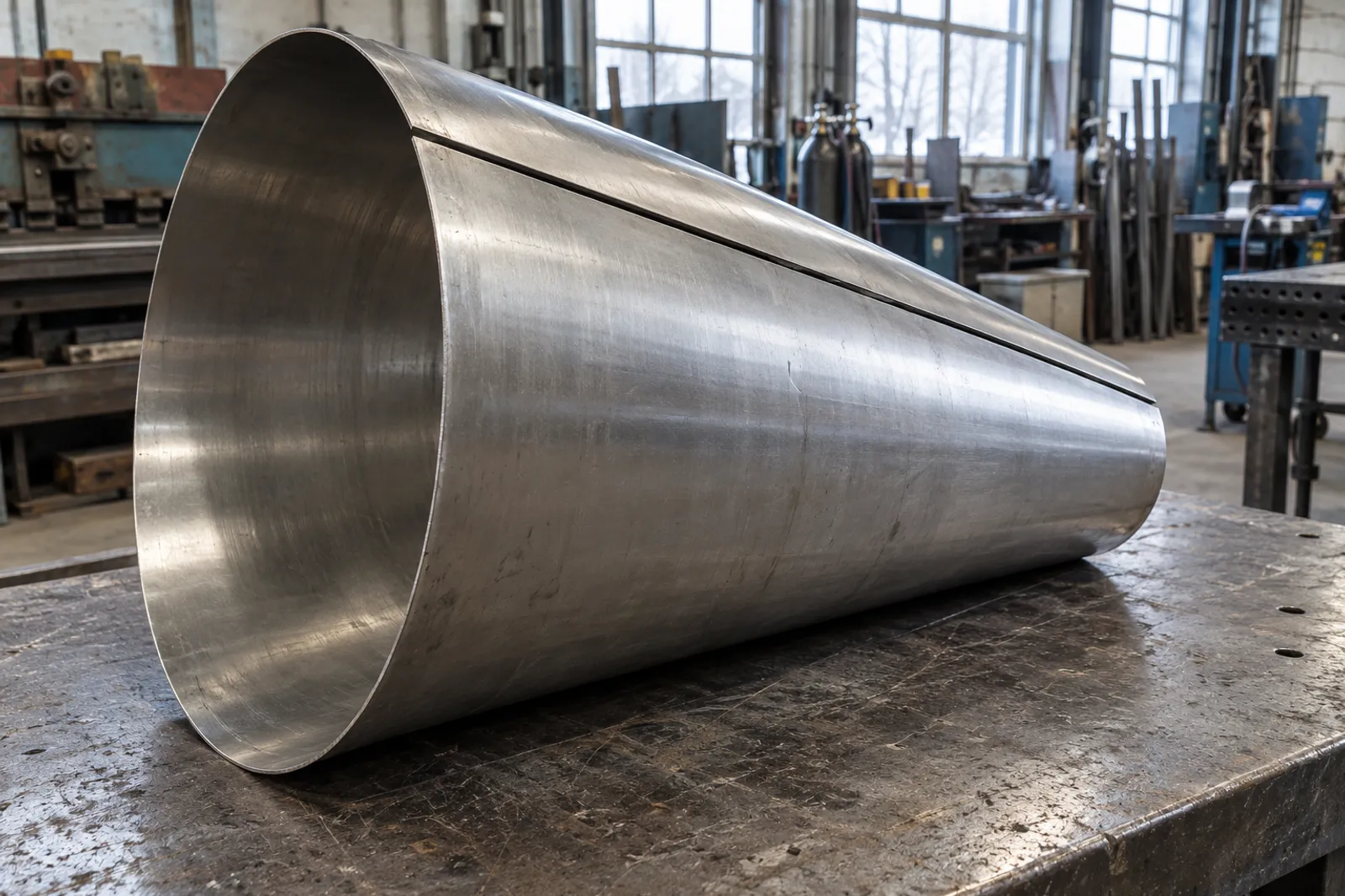
Shells, cones and open arcs aren't described the same way
In brief: each rolled shape has its critical piece of information, and it's the one most often missing from drawings.
The hopper of a grain silo in Montérégie, the process duct of a Mauricie paper mill and the shell of one of a dairy plant's stainless tanks can come off the same plate roll, but not from the same drawing. The open arc, for its part, is used for canopies and curved cladding.
Before sending the drawing, check the row for your part:
| Rolled shape | What the drawing must specify | What the shop derives from it |
|---|---|---|
| Closed shell | Inside, outside or mean diameter; height; seam position | Developed length and pre-bending of both edges |
| Truncated cone | Both diameters and their reference; height or angle | Development as a ring segment, cut before rolling |
| Open arc | Radius, arc length or chord; direction of the curve | Straight edges to trim or pre-bend |
| Multi-plate shell | Number of seams and angular offset | Seams placed away from nozzles and supports |
The cone row is the one filled in worst. Its small end travels less distance than the large end on each turn, and a very open or very closed cone is sometimes formed in welded segments.
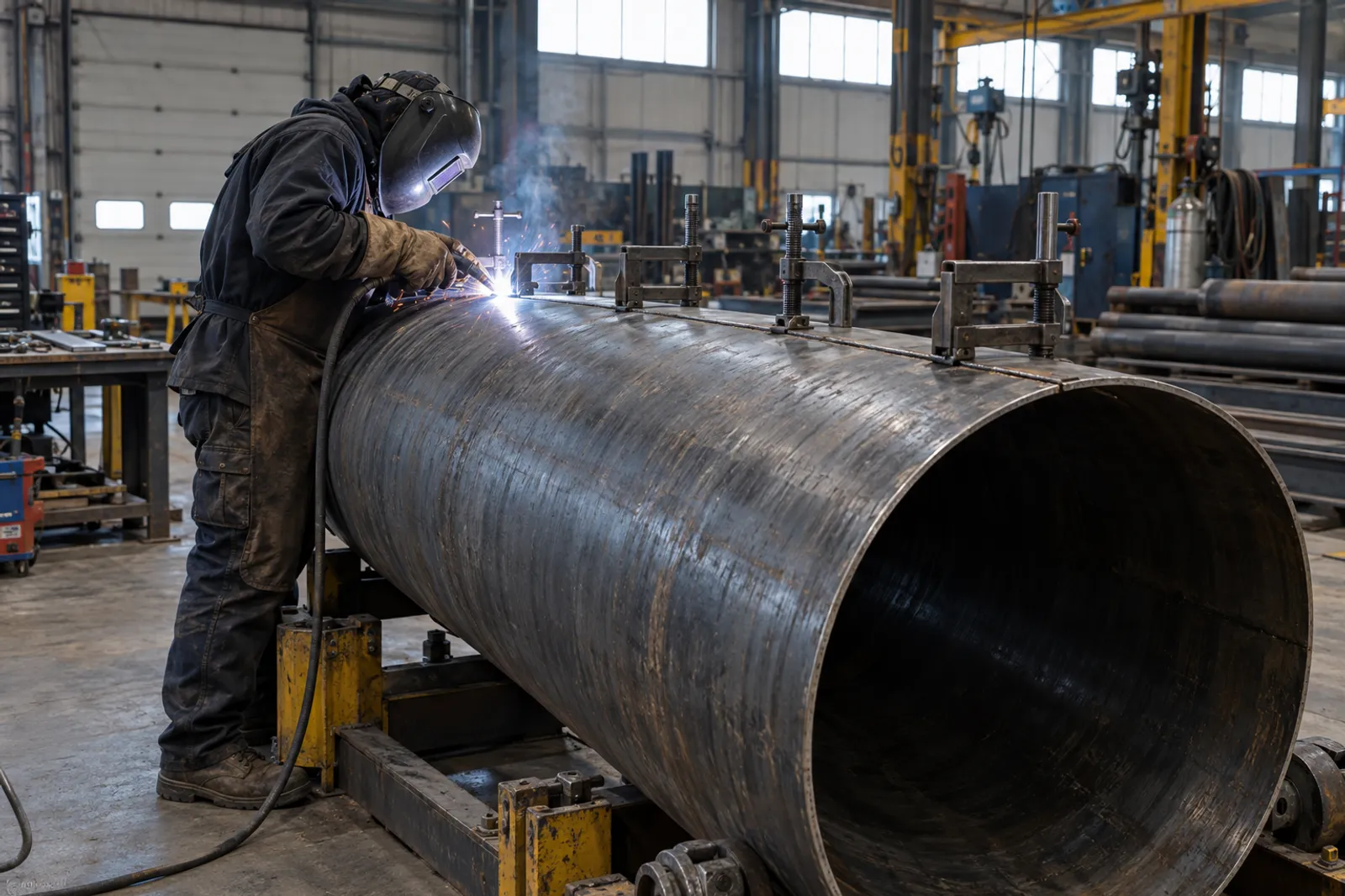
Conclusion
A shell or cone produced by steel plate rolling fits up the first time when the drawing carries four lines: the diameter reference, the seam position, the expected pre-bending and the actual grade. A missing line is paid for at assembly, when it's too late to recut.
A PDF or DWG drawing with those four lines can be attached to the quote request form to have the development and pre-bending validated before cutting.
FAQ
How thick can steel plate rolling go?
It depends on the plate roll, the grade and the diameter. A machine's rated capacity pairs a maximum thickness with a plate width, often measured on mild steel, for example ½ in over 10 ft. The smaller the target diameter, the higher the force, and stainless or duplex plate rolling allows a lower thickness. Confirmation is done on the actual drawing.
What's the difference between plate rolling and plate bending?
In everyday use, almost none. Both terms describe gradually curving a plate between rolls, and drawings use plate bending and plate rolling interchangeably. Press braking, on the other hand, forms a sharp angle on a press brake. Bump bending sits between the two: a series of small, closely spaced bends that mimics a curve, used to pre-bend edges or for large radii.
Can stainless be rolled on the same plate roll as black steel?
Yes, as long as the rolls are cleaned first. Iron particles left by carbon steel become embedded in stainless under pressure and then rust in service, especially in wet or chloride environments. The fabrication guide published by IMOA in 2020 recommends thorough cleaning of the rolls and a protective film on the plate. The sensitive face is specified on the drawing before rolling.
How do you avoid a flat spot at a shell seam?
By pre-bending both edges of the plate before full rolling. A 4-roll plate roll does it without removing the plate. A 3-roll initial-pinch plate roll requires flipping it, and a pyramid plate roll requires pre-bending on a press brake. A flat spot that's already formed is hard to correct after welding: the seam comes out peaked and the shell no longer fits its flange.
What do the French terms on a Quebec drawing mean?
Quebec drawings often use French terms: « roulage » or « cintrage » for plate rolling, « virole » for the shell, « tronc de cône » for the truncated cone and « précintrage » or « croquage » for pre-bending. The diameter dimension usually carries ID for inside or OD for outside. Without one of those two notes, the diameter reference should be confirmed in writing.